Ask a chemist selecting an ionic liquid how they chose the alkyl chain length on their cation, and the honest answer is usually: they didn’t. They picked 1-ethyl-3-methylimidazolium or 1-butyl-3-methylimidazolium because that’s what the literature used, and the chain length came along for the ride. This is understandable. The cation family and anion combination tend to dominate the discussion. Nevertheless, it’s also a missed opportunity, because the alkyl chain is not an inert appendage. It controls the internal architecture of the liquid at the nanoscale, and that architecture determines whether your ionic liquid performs brilliantly or fails quietly in your application.

Ionic Liquids Are Not Homogeneous Solvents

For the first decade of modern ionic liquid research, these materials were treated as homogeneous “liquid salts” — structurally uniform at the molecular level, with properties that could be predicted from simple ion-pair considerations. Early influential reviews described their structure as unlikely to differ greatly from molten salts. That picture changed decisively in the mid-2000s.

In 2006, Canongia Lopes and Pádua published molecular dynamics simulations showing that ionic liquids with sufficiently long alkyl chains spontaneously segregate into polar and nonpolar nanodomains (J. Phys. Chem. B 2006, 110, 3330). Specifically, the polar regions consist of cation head groups and anions, held together by Coulombic interactions. The nonpolar regions consist of aggregated alkyl chains, interacting through weaker van der Waals forces. A year later, Triolo, Russina, Bleif, and Di Cola provided the first experimental X-ray diffraction evidence confirming these predictions in neat room-temperature ionic liquids (J. Phys. Chem. B 2007, 111, 4641).

Key Experimental Evidence

The critical finding from Triolo’s work: domain size scales linearly with alkyl chain length, increasing by 2.1 Å per CH2 unit. At C3 (propyl), no diffraction peak is observed — the liquid looks structurally homogeneous. By C4 (butyl), a broad hump appears. At C6, C8, and C10, the peak becomes progressively sharper and more intense, indicating increasingly well-defined nanoscale organization. Domain spacings range from roughly 15 Å at C4 to 27 Å at C10.

Importantly, subsequent work confirmed that this nanostructuring is largely independent of the anion. Triolo’s group showed that chloride, tetrafluoroborate, and hexafluorophosphate salts all produce nearly identical domain spacings for the same cation chain length. The anion occupies space in the polar domain and influences local packing, but the nanoscale segregation itself is driven almost entirely by alkyl chain aggregation. As a result, Hayes, Warr, and Atkin compiled these findings across the entire field in their comprehensive 2015 review (Chem. Rev. 2015, 115, 6357), establishing nanostructuring as one of the defining features of ionic liquid behavior.

From Globular Islands to a Bicontinuous Sponge

The nanostructure is not the same at every chain length — it undergoes a qualitative morphological transition as the alkyl chain grows. Understanding this transition is essential for predicting how a given ionic liquid will behave.

At short chain lengths (C2), the nonpolar domains are small, disconnected globular “islands” of hydrocarbon embedded in a continuous ionic matrix. Consequently, the charged network dominates. As a result, these liquids behave approximately as the homogeneous solvents they were once assumed to be.

The Three Structural Regimes

At C4 (butyl), the system reaches a structural crossover. The alkyl domains begin to connect, forming the onset of a percolated network. This is the chain length at which a low-Q diffraction peak first becomes experimentally detectable — marking the transition from a liquid with local heterogeneities to one with genuine mesoscale order.

At C6 and beyond, the nonpolar domains interconnect fully into a bicontinuous, sponge-like nanostructure. The liquid now consists of two interwoven, continuous subvolumes — one polar, one nonpolar — resembling the L3 sponge phase familiar from surfactant science. The area ratio of polar to nonpolar interfaces (aalkyl/apolar) approaches unity, which is the hallmark of a locally planar, bicontinuous architecture. This is not a micelle-like structure with discrete aggregates — it is a connected, interpenetrating network.

Ultimately, this morphological progression — globular to percolated to bicontinuous — matters because it changes what the liquid can do. For example, a C2 ionic liquid with isolated nonpolar pockets has fundamentally different solvation, transport, and interfacial behavior than a C8 ionic liquid with a fully connected sponge-like architecture.

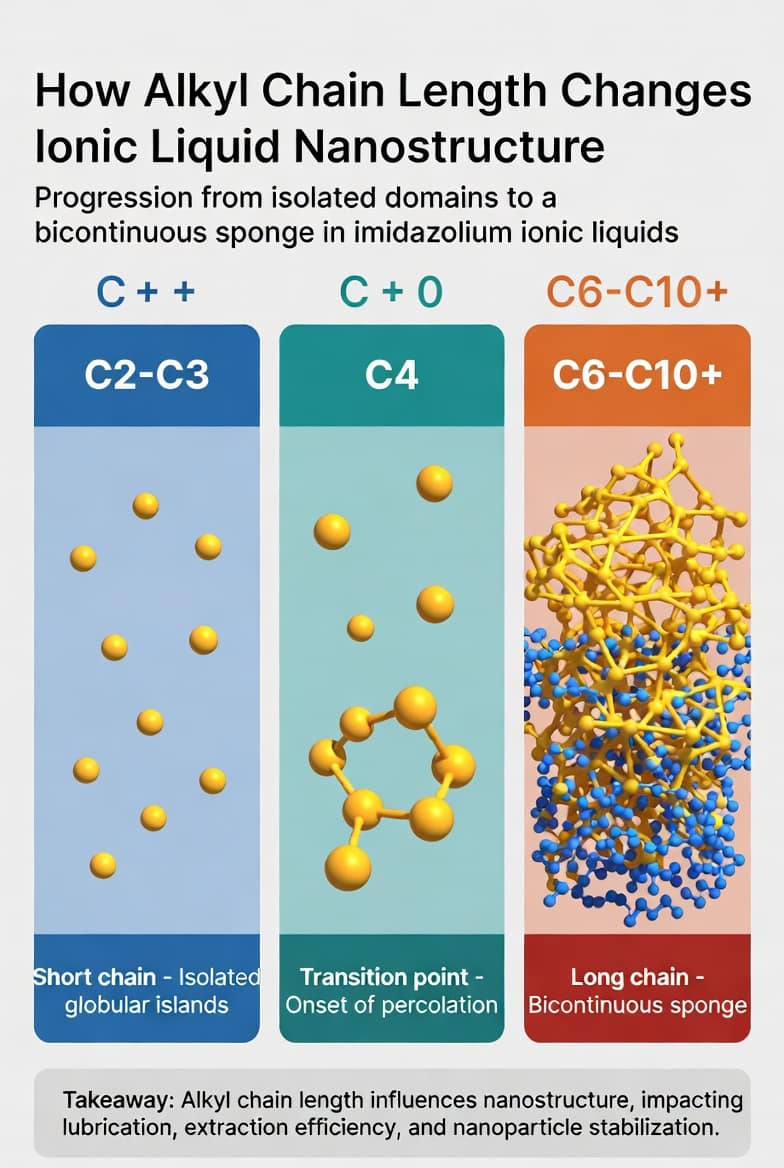
Diagram showing how imidazolium ionic liquids develop nanoscale segregation as the alkyl chain length increases. On the left, short‑chain cations (C2–C3) form small, isolated nonpolar clusters dispersed within a continuous polar network. In the middle, intermediate chains (around C4) show the first signs of percolation, where nonpolar regions begin to connect. On the right, long‑chain cations (C6–C10 and above) create a fully bicontinuous, sponge‑like structure with intertwined polar and nonpolar domains. A corresponding SAXS trend indicates the emergence and growth of a low‑Q nanostructuring peak as chain length increases.
Figure 1: How Alkyl Chain Length Drives Nanoscale Segregation in Imidazolium Ionic Liquids. This figure illustrates the structural evolution of ionic liquids as the alkyl chain length on the imidazolium cation increases. Short chains (C2–C3): Non-polar domains exist as isolated globular aggregates dispersed in the polar network. Intermediate chains (C4): Onset of percolation — non-polar domains begin to connect, marking a key structural transition. Longer chains (C6–C10+): Formation of a fully bi-continuous sponge-like morphology with interpenetrating polar and non-polar domains. This progression is supported by small-angle X-ray scattering (SAXS) studies, which show the emergence and growth of a characteristic low-Q nano-structuring peak with increasing chain length. The trend is observed across different anions (Cl⁻, PF₆⁻, and Tf₂N⁻), though the exact chain length where strong segregation appears can vary slightly with anion identity. Adapted and simplified from Hayes, R.; Warr, G. G.; Atkin, R. Chem. Rev. 2015, 115, 6357–6426.


When Nano-structuring Works for You

The presence of organized nonpolar nanodomains creates capabilities that a homogeneous ionic solvent cannot provide. Moreover, the bicontinuous architecture is particularly powerful because both polar and nonpolar domains are continuous and accessible throughout the liquid. Three application areas illustrate this.

Lubrication and Surface Protection

At a metal surface, ionic liquids with longer alkyl chains form layered adsorbed films: the charged head groups orient toward the surface, while the alkyl tails extend outward, creating an ordered molecular brush. This interfacial layering is a direct extension of the bulk nanostructure — the sponge-like morphology in the bulk becomes lamellar-like near the solid interface, as the surface aligns and flattens the pre-existing polar/nonpolar domains. Longer chains produce thicker, more robust films that resist being squeezed out under compression. Huang et al. (ACS Omega 2024, 9, 3184) showed that both friction reduction and wear protection correlate positively with cation chain length, with the mechanism being twofold: more stable adsorbed layers and milder tribochemical reactions at the surface.

For lubrication work, RoCo® recommends starting with HMIm-TFSI (C6, IL-0098) or OMIm-TFSI (C8, IL-0099) — both fall squarely in the bicontinuous sponge regime.

Selective Solvation and Extraction

The coexistence of polar and nonpolar domains within a single liquid phase means an ionic liquid can simultaneously accommodate solutes of very different polarity. Polar species dissolve into the ionic regions; nonpolar species partition into the hydrocarbon-like nanodomains. Rather, this is not merely a polarity effect — it is a consequence of the liquid having two distinct, structured microenvironments. A C2 ionic liquid offers limited partitioning capability because its nonpolar domains are small, disconnected pockets. A C8 ionic liquid provides substantial, interconnected nonpolar volume that can accommodate hydrophobic solutes, catalytic intermediates, or extraction targets.

For extraction and selective solvation, OMIm-TFSI (C8, IL-0099) and DMIm-TFSI (C10, IL-0100) are our most-specified grades.

Nanoparticle Stabilization

When a nanoparticle is dispersed in a nanostructured ionic liquid, the alternating polar/nonpolar layers wrap around it like concentric shells, creating oscillatory solvation forces — energy barriers that resist aggregation. As a result is kinetic stabilization without added surfactants. Longer alkyl chains produce more pronounced layering and stronger barriers. The C8 system shows significant domain segregation and effective stabilization; the C4 system does not. This is why the size distribution of metal nanoparticles synthesized in ionic liquids is related to the degree of internal nanostructure — nucleation and growth appear to be localized within the nonpolar domains.

For nanoparticle synthesis and stabilization, OMIm-TFSI (C8, IL-0099) is the standard starting point; DDMIm-TFSI (C12, IL-0101) may offer extra benefits in stabilization of nano particles.

When Nanostructuring Works Against You

The same structural features that make nanostructured ionic liquids excellent lubricants and selective solvents make them poor electrolytes. Understanding why requires looking at what the bicontinuous sponge does to ion transport.

Ion Transport and Conductivity

In an electrolyte, what matters is how efficiently ions move from one electrode to the other. Nonpolar nanodomains are, by definition, regions that do not conduct ionic charge. As the alkyl chain lengthens and these domains grow from disconnected pockets into a connected sponge, they become an increasingly effective barrier — dead zones that ions must navigate around. Consequently, ionic conductivity decreases systematically with increasing chain length: within the imidazolium TFSI series, moving from C2 to C8 can reduce conductivity by roughly half.

The Walden plot makes this particularly visible. As chain length increases, ionic liquids deviate further below the ideal Walden line, indicating that a growing fraction of ions are moving as correlated pairs or clusters rather than as free charge carriers. The nanostructure is not just slowing transport — it is reducing the effective number of independent charge carriers.

Viscosity

Viscosity rises steeply with chain length. The dominant contribution comes from van der Waals interactions between alkyl chains within the nonpolar domains — chains entangle, interdigitate, and resist flow. For the imidazolium TFSI series, viscosity can increase by an order of magnitude between C2 and C10. The practical consequence is slower mass transport, slower electrode kinetics, and more difficult processing.

Mesophase Formation at Long Chain Lengths

Beyond approximately C12, many ionic liquids cross a structural threshold. The alkyl chains become long enough to pack into ordered lamellar, columnar, or smectic phases that resemble liquid crystals more than free-flowing liquids. Melting points, which initially decrease with chain length (disrupting crystal packing symmetry), begin to rise again past C10 as cohesive van der Waals interactions dominate. If what you need is a mobile, isotropic solvent, a C14 or C16 ionic liquid may not cooperate.

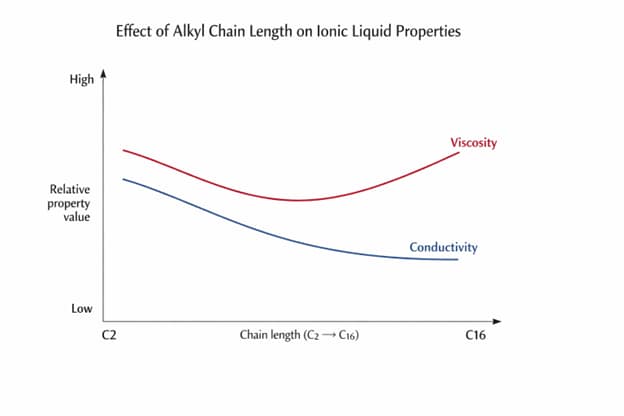
chart showing viscosity increasing, conductivity decreasing, as chain length increases from C2 to C16
Figure 2: Qualitative property trend chart showing viscosity increasing, conductivity decreasing, as chain length increases from C2 to C16. Note this is an observed trend only and depends on the selection of anion, cation as well as mixtures of ILs.

Why This Matters: ILs Are Structurally Unique Among Solvents

It is worth pausing to appreciate how unusual this nanostructuring is. Virtually every other class of liquid solvent — atomic, diatomic, molecular, even molten salts — lacks structure beyond a preferred separation between adjacent molecules. Water has its tetrahedral hydrogen bond network; alcohols form chain-like aggregates; molten NaCl shows charge ordering over a few coordination shells. But none of these possess a repeat correlation length between organized domains. Ionic liquids do. They have a preferred separation, a preferred orientation, and a periodic nanoscale architecture. This makes them more structurally analogous to microemulsions or liquid crystals than to conventional solvents — except that the nanostructure forms spontaneously in the pure liquid, without requiring a second component or surfactant.

Indeed, this structural uniqueness is not academic. It is why ionic liquids can simultaneously dissolve polar and nonpolar solutes, why they form robust interfacial films, why they stabilize nanoparticles, and why they penalize ion transport at longer chain lengths. In short, the nanostructure is the mechanism behind all of these behaviors.

Chain Length as a Nanostructure Design Parameter

Taken together, the picture that emerges is consequential: the alkyl chain length does not simply adjust viscosity or conductivity on a sliding scale. Instead, it controls whether and to what extent an ionic liquid develops internal nanostructure — and through what morphology — and that nanostructure determines performance in fundamentally different ways depending on the application.

For instance, for an electrolyte, the optimal chain length is short — C2 or C3 — because the priority is fast ion transport, high conductivity, and minimal ion correlation. You want the globular regime, where the nonpolar domains are too small to impede transport.

Similary, for a lubricant additive, the optimal chain length is longer — C6 to C8 or beyond — because the priority is a thick, ordered adsorbed film at the surface. You want the bicontinuous sponge regime, where the nanostructure is the mechanism of action.

For extraction or catalysis involving hydrophobic substrates, the chain length determines how much nonpolar solvent capacity exists within the ionic matrix. Too short and the ionic liquid cannot accommodate the substrate; too long and the liquid becomes impractically viscous.

Matching Chain Length to Your Application

There is no universally “best” chain length. There is only the chain length that matches the nanostructural requirements of your application.

At RoCo®, we maintain the full 1-alkyl-3-methylimidazolium TFSI series from C2 through C16 precisely because this range spans the full spectrum of nanostructural behavior: from minimal domain segregation at C2 to pronounced bicontinuous sponge-like nanostructuring at C8, to mesophase-forming compositions at C14 and C16. The same depth exists across our pyrrolidinium, piperidinium, and phosphonium product lines. We stock this breadth because years of working with these materials have taught us that chain length is a design decision, not an afterthought.


Selecting the Right Chain Length for Your Application

If you’re developing an application where ionic liquid selection matters — whether in energy storage, lubrication, separations, or advanced materials — the alkyl chain length is one of the most consequential decisions you’ll make. RoCo®‘s technical team brings deep structure-property expertise to that decision, and as a North American distributor of IoLiTec, we deliver one of the world’s largest ionic liquid catalogs with U.S.-based logistics.

Two ways to move forward:

  • Contact us to reach out technical team
  • Browse the catalog — explore our full ionic liquid catalog to see the range of chain lengths available across cation families.


References

Triolo, A.; Russina, O.; Bleif, H.-J.; Di Cola, E. “Nanoscale Segregation in Room Temperature Ionic Liquids.” J. Phys. Chem. B 2007, 111, 4641–4644.

Canongia Lopes, J. N.; Pádua, A. A. H. “Nanostructural Organization in Ionic Liquids.” J. Phys. Chem. B 2006, 110, 3330–3335.

Hayes, R.; Warr, G. G.; Atkin, R. “Structure and Nanostructure in Ionic Liquids.” Chem. Rev. 2015, 115, 6357–6426.

Huang, G.; Sun, L.; Li, L.; et al. “Exploring the Effect Mechanism of Alkyl Chain Lengths on the Tribological Performance of Ionic Liquids.” ACS Omega 2024, 9, 3184–3192.

Wang, Y.; Voth, G. A. “Molecular Dynamics Simulations of the Structural Organization in RTILs.” J. Am. Chem. Soc. 2005, 127, 12192.

Russina, O.; Triolo, A. “Faraday Discussions on the Mesoscopic Model.” Faraday Discuss. 2012, 154, 97–109.

Tokuda, H.; Hayamizu, K.; Ishii, K.; Susan, M. A. B. H.; Watanabe, M. “Physicochemical Properties and Structures of RTILs.” J. Phys. Chem. B 2005, 109, 6103–6110.

Cai, M.; Yu, Q.; Liu, W. “Ionic Liquid Lubricants: When Chemistry Meets Tribology.” Chem. Soc. Rev. 2020, 49, 7753–7818.

Pensado, A. S.; Pádua, A. A. H. “Solvation and Stabilization of Metal Nanoparticles in Ionic Liquids.” Angew. Chem. Int. Ed. 2011, 50, 8683–8687.

Table 1: RoCo®‘s CnMIM-TFSI Series: Full Chain Length Range

Chain Common Name SKU CAS Viscosity (cP) (RT) ECW (V) (RT) Nanostructure Regime Primary Use
C2 (ethyl) EMIm-TFSI IL-0023-UP/ IL-0023-OP 174899-82-2 ~39 ~4.7 Homogeneous – no domains Electrolytes, high-conductivity applications
C3 (propyl) PMIm-TFSI IL-0024-HP/

IL-0024-UP

216299-72-8 56 (19°C) ~4.9 Pre-threshold – onset Electrolytes, transitional, solvents
C4 (butyl) BMIm-TFSI IL-0029-UP/IL-0029-OP 174899-83-3 48.8 4.62 Percolation threshold – domains emerge Electrolytes, solvent, solar cells
C5 (pentyl) C5MIm-TFSI IL-0300-HP 280779-53-5 59.3 Early bicontinuous Research
C6 (hexyl) HMIm-TFSI IL-0098-HP/IL-0098-UP 382150-50-7 ~63 5.3 Bicontinuous sponge Lubrication, extraction
C7 (heptyl) C7MIm-TFSI IL-0301-HP 425382-14-5 Bicontinuous sponge Research, extraction
C8 (octyl) OMIm-TFSI IL-0099-HP 178631-04-4 106 Full bicontinuous Lubrication, hydrophobic extraction
C9 (nonyl) NonMIm-TFSI IL-0302-HP 433337-21-4 Transitional bicontinuous Catalysis, Supported ionic liquid phase, lubricants
C10 (decyl) DMIm-TFSI IL-0100-HP 433337-23-6 113 4.6 Mature bicontinuous Extraction, advanced lubrication, catalysis
C12 (dodecyl) DDMIm-TFSI IL-0101-HP 404001-48-5 213.7 (18°C) Approaching mesophase Specialized surface applications, Research, catalysis, lubrication
C14(tetradecyl) TETRADECMIm -TFSI IL-0102-HP 404001-49-6 Mesophase / liquid crystal-like Coatings, Extraction, oil and gas, supported ionic liquid phase, lubricants
C16 (hexadecyl) HDMIm-TFSI IL-0103-HP 404001-50-9 Mesophase / liquid crystal-like Surface coatings, surfactant, nano material synthesis
C18

(octadecyl)

OctadecMIM-TFSI IL-0200-HP 404001-51-0 Liquid crystal like Coatings, extraction

Frequently Asked Questions

What alkyl chain length is best for ionic liquid electrolytes?

Short chains – C2 (ethyl) or C3 (propyl) – are optimal for electrolyte applications. At these lengths, nonpolar nanodomains remain small and disconnected, preserving fast ion transport and high ionic conductivity. Moving from C2 to C8 within the imidazolium TFSI series can reduce conductivity by roughly half.

What purity grades does RoCo® offer for imidazolium-TFSI ionic liquids?

Most CnMIM-TFSI products are available in three grades: HP (>99%, suitable for most synthesis and screening work), UP (>99.5%, for electrochemistry and analytical applications where trace halides matter), and OP (>99.9%, for battery electrolytes and high-end research). Grade selection depends on whether residual chloride or water will affect your results — the applications team can advise.

What are typical lead times for ionic liquid orders?

In-stock SKUs from the RoCo® catalog typically ship within 3-5 business days from U.S. inventory. Custom synthesis and bulk quantities are quoted on request; as a North American distributor of IoLiTec, RoCo® can also source the broader IoLiTec catalog with reduced transit time compared to direct European import.

Can I order imidazolium-TFSI ionic liquids in kilogram quantities?

Yes. Most catalog SKUs are listed in gram quantities online, but kilogram and multi-kilogram orders are available on request for scale-up and pilot work. Contact the applications team for pricing and lead time on quantities above the listed catalog sizes.

At what chain length does nanostructuring appear in imidazolium ionic liquids?

Nanostructuring becomes experimentally detectable by small-angle X-ray scattering at C4 (butyl). Below C4, the liquid appears structurally homogeneous. At C4, a broad diffraction peak emerges, and by C6 through C10 the peak sharpens progressively, indicating well-defined polar and nonpolar nanodomains.

Why do longer alkyl chain ionic liquids have higher viscosity?

Van der Waals interactions between alkyl chains within the nonpolar nanodomains are the primary driver. As chains lengthen, they entangle and interdigitate within these domains, resisting flow. Viscosity in the imidazolium TFSI series can increase by an order of magnitude between C2 and C10.

Which ionic liquid chain length is best for lubrication?

C6 to C8 is the practical optimum for most lubrication applications. At these lengths, the bicontinuous sponge-like nanostructure is fully developed, enabling thick, ordered adsorbed films at metal surfaces. Longer chains produce more robust films but at the cost of higher viscosity and more difficult handling.

Does the anion affect ionic liquid nanostructure?

The anion has minimal effect on nanoscale domain spacing. Triolo et al. showed that chloride, tetrafluoroborate, and hexafluorophosphate salts produce nearly identical domain spacings for the same cation chain length. The anion occupies the polar domain and influences local packing but does not drive the nanoscale segregation, which is controlled by alkyl chain aggregation.

What happens to ionic liquid structure above C12?

Beyond approximately C12, many ionic liquids begin forming ordered lamellar or smectic phases resembling liquid crystals. Melting points, which initially decrease with chain length, begin rising again past C10 as van der Waals cohesion between chains dominates. These materials may no longer behave as free-flowing isotropic liquids at room temperature.

Imidazolium vs. Pyrrolidinium: The Real Trade‑Offs in Ionic Liquid Electrolytes


How molecular structure dictates every trade‑off—and how we can sometimes bend the rules

A technical blog for the curious electrochemist.

Executive Summary:

Imidazolium ionic liquids are fast (low viscosity, high conductivity) but cathodically fragile, while pyrrolidinium ionic liquids are slower but far more resilient at low potential—and formulation choices can shift the balance, but they rarely erase the trade‑off entirely.


Why these two cation families dominate the conversation

At RoCo, we spend a lot of time designing electrolytes—ionic liquids and ionic polymers—for operating conditions where volatility, flammability, and narrow voltage windows are non‑starters. When ionic liquids enter the discussion, two cation families show up again and again: imidazolium and pyrrolidinium. They’re commonly paired with TFSI⁻ (bis(trifluoromethanesulfonyl)imide) because TFSI⁻ tends to deliver high thermal stability and wide anodic stability.

The choice is often presented as a simple pick between “higher conductivity” and “wider electrochemical window.” In practice, that framing is incomplete. The transport penalty (viscosity, conductivity) and the stability penalty (cathodic breakdown pathways) are both direct consequences of molecular structure. Below, we lay out the head‑to‑head numbers, explain the molecular reasons, and then highlight one deeper point: viscosity is not destiny—ionicity can be engineered.

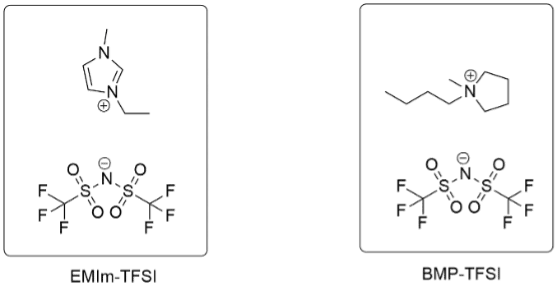
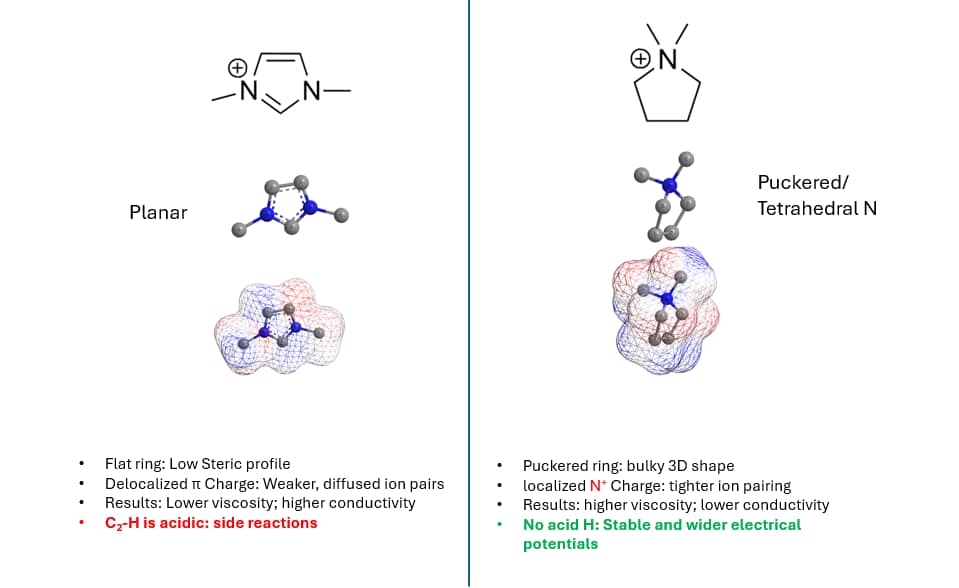
Figure 1. Representative structures: EMIm‑TFSI and BMP‑TFSI.

The head‑to‑head: Properties at a glance

Table 1 summarizes practical, experimentally observed ranges for two workhorse ionic liquids: EMIm‑TFSI (1‑ethyl‑3‑methylimidazolium) and BMP‑TFSI (N‑butyl‑N‑methylpyrrolidinium). Values vary with water content, salt loading, temperature, and electrode material, but the ordering is robust.

Property EMIm‑TFSI BMP‑TFSI Winner
Melting point (°C) −15 to −17 −18 to −20 ≈ Tie
Viscosity at 25 °C (cP) ~32–38 ~75–95 Imidazolium
Ionic conductivity (mS cm⁻¹) ~8–11 ~2–4 Imidazolium
Practical electrochemical window (V) ~4.0–4.5 ~5.5–6.0 Pyrrolidinium
Cathodic limit vs. Li/Li⁺ ~1.0–1.2 V (NHC/carbene pathway) ≈ 0 V (Li plating possible) Pyrrolidinium
Li⁺ transference number* ~0.1–0.2 ~0.08–0.15 ≈ Tie
Thermal stability, T₅% (°C) ~380–420 ~380–410 ≈ Tie

*Strongly dependent on salt concentration, temperature, and measurement method.

The pattern is immediate: imidazolium wins on transport (lower viscosity, higher conductivity), while pyrrolidinium wins on cathodic robustness and therefore usable voltage window for lithium metal. That’s the “no free lunch” principle in electrolyte design.

Why imidazolium is faster: aromaticity, planarity, and weaker ion correlation

Imidazolium is a five‑membered aromatic ring with a delocalized positive charge. Two practical consequences follow. First, the cation is relatively planar, which tends to reduce steric resistance to translation and rotation in the liquid. Second, charge delocalization can weaken the persistence of tight contact ion pairs with TFSI⁻, improving mobility. Together, these effects drive lower viscosity and higher conductivity.

Pyrrolidinium cations are saturated rings with a more localized positive charge on nitrogen and a puckered, three‑dimensional geometry. That increases effective hydrodynamic volume and strengthens ion–ion correlations, so viscosity rises and conductivity falls. In batteries, that shows up as higher polarization—unless you compensate with temperature, electrode architecture, or formulation.

Figure 2: Qualitative geometry contrast: planar aromatic imidazolium vs. puckered saturated pyrrolidinium.

The carbene problem: Why many imidazoliums fail before you reach anode potential

The same imidazolium chemistry that improves transport creates a well‑known cathodic failure mode. The C2–H position (between the two nitrogens) is relatively acidic. Under sufficiently reducing conditions, it can participate in reactions that generate N‑heterocyclic carbene (NHC) character, triggering electrolyte decomposition and resistive interphase formation. Practically, that often limits EMIm‑TFSI to ~1.0–1.2 V vs. Li/Li⁺ and makes it a poor fit for lithium metal anodes.

Pyrrolidinium cations have no aromatic C2–H analogue. Their cathodic stability extends close to 0 V vs. Li/Li⁺, so lithium plating and stripping are electrochemically accessible. That does not imply chemical inertness: BMP‑TFSI can still be reduced on reactive surfaces, and SEI formation still occurs. The difference is that the electrochemical window is wide enough to operate a lithium metal system with manageable interphase chemistry.

Blocking the C2 position in imidazolium (e.g., C2‑methylation) suppresses the carbene pathway, but introduces new trade‑offs. Viscosity typically increases and ionicity can decrease as local structure and ion association change. You gain chemical stability but often surrender part of the transport advantage that drew you to imidazolium in the first place.


Beyond viscosity: Why the Walden rule is incomplete

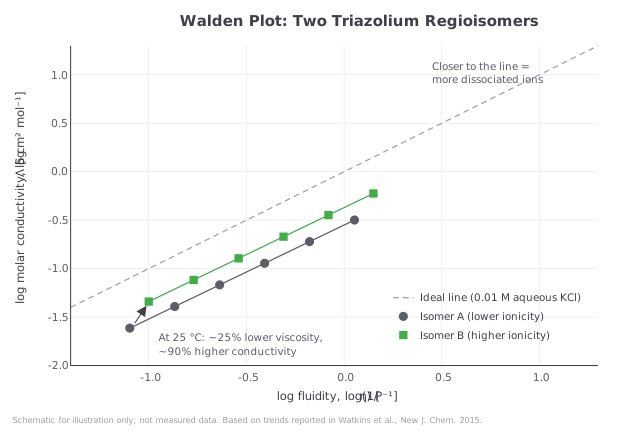
A standard heuristic in ionic liquids is the Walden rule: conductivity scales inversely with viscosity. As a first pass, it explains a lot—especially the imidazolium vs. pyrrolidinium contrast. But it also hides a second control knob: ionicity.

Viscosity tells you how fast species can move. Ionicity tells you what fraction of that motion actually carries charge (as opposed to moving as neutral or weakly charged pairs/clusters). From an engineering perspective, this distinction matters because it determines whether conductivity losses are fundamentally structural or merely kinetic—and only the latter can be recovered through temperature or formulation changes.


Lessons from triazoliums: Tuning ionicity without “just lowering viscosity”

In our published work on 1,2,3‑triazolium ionic liquids, we found clear examples where small structural changes shift ionicity enough to move conductivity beyond what viscosity alone would predict. In one study, two regioisomers with identical formulas (same mass, same anion) showed markedly different Walden behavior. The difference was not “how long the chain was,” but where that chain sat relative to the charged center—changing steric accessibility and the persistence of ion pairing.

The takeaway is not that triazolium is a magic cation. It’s that structure–property relationships in ionic electrolytes are constraints, not commandments. Regioisomerism, branching, and local sterics can tune ion association and effective charge transport—sometimes letting you bend the usual viscosity–conductivity trade‑off.


What this means for electrolyte design (ionic liquids and ionic polymers)

  • If your anode never approaches lithium metal potentials (e.g., many intercalation systems), imidazolium‑TFSI can offer useful conductivity and anodic stability—so long as you stay away from the cathodic failure mode.
  • If you need operation near 0 V vs. Li/Li⁺ (lithium metal, aggressive anode chemistries), pyrrolidinium‑TFSI is the more robust starting point, and you manage viscosity via temperature, salt selection, or architecture.
  • If you’re building ionic polymers or gelled ionic systems, the same logic applies: segmental motion sets the kinetic ceiling, but ionicity (how “free” the charge carriers are) often determines real conductivity.


How we think about this at RoCo

The imidazolium–pyrrolidinium comparison is a canonical example of an engineering trade‑off that starts at the molecular scale. Imidazolium buys transport through aromaticity and charge delocalization, but pays for it with cathodic fragility. Pyrrolidinium removes that failure mode, but accepts higher viscosity and lower conductivity. Neither is “better” in the abstract; the right choice depends on voltage window, electrode chemistry, and operating conditions.

Where the field still has room to grow—and where we focus—is in deliberately breaking assumed couplings between viscosity, ionicity, and stability. If you know where they break, you can design electrolytes that operate intentionally at (or just beyond) those boundaries.


Electrolytes (Ionic Liquids and Ionic Polymers). Further Reading and Primary Sources

(1) Watkins, T.; Roth, E. A.; Lartey, M.; Albenze, E.; Zhong, C.; Luebke, D. R.; Nulwala, H. B. Ionic Liquid Regioisomers: Structure Effect on the Thermal and Physical Properties. New J. Chem. 2015, 39, 1563–1566. https://doi.org/10.1039/C4NJ02044G.

(2) Lartey, M.; Meyer-Ilse, J.; Watkins, T.; Roth, E. A.; Bowser, B.; Kusuma, V.; Damodaran, K.; Zhou, J.; Haranczyk, M.; Albenze, E.; Luebke, D. R.; Hopkinson, D.; Kortright, J.; Nulwala, H. B. Branched Isomeric 1,2,3-Triazolium-Based Ionic Liquids: New Insight into Structure–Property Relationships. Phys. Chem. Chem. Phys. 2015, 17, 29834–29843. https://doi.org/10.1039/C5CP04630A.

(3) Nulwala, H. B.; Tang, S.; Kail, B. W.; Damodaran, K.; Kaur, P.; Wickramanayake, S.; Shi, F.; Luebke, D. R. Probing the Structure–Property Relationship of Regioisomeric Ionic Liquids with Click Chemistry. Green Chem. 2011, 13, 3345–3349. https://doi.org/10.1039/C1GC15721F.

Acoustic Performance of Rigid and Flexible Polyurethane Foams (PU) Using  Functional Powder Additives

Noise, Vibration, and Harshness (NVH) performance is becoming a priority across construction materials, industrial equipment, and consumer products. RoCo’s latest white paper demonstrates how upcycled polyurethane (PU) powder additives can significantly improve the acoustic behavior of both rigid and flexible PU foams — without changing chemistry, equipment, or manufacturing processes.

Key Findings:

Rigid PU Foam — Softer, Less Harsh Impact Noise

Impact testing shows that adding 5–10% upcycled PU powder to rigid foam produces measurable improvements in both sound intensity and perceived harshness.

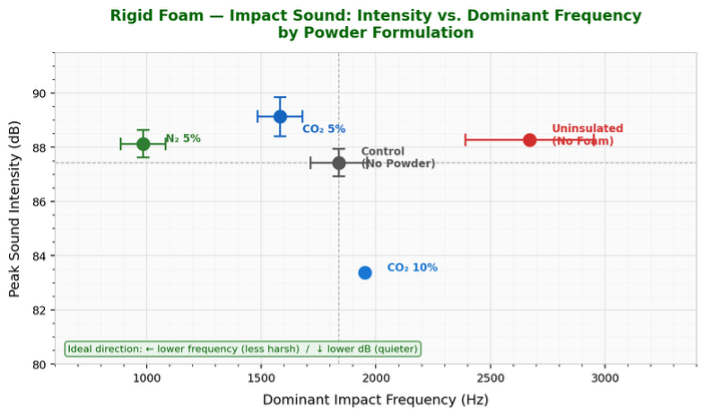
Rigid foam impact results: peak sound intensity (dB) vs. dominant frequency (Hz) by formulation.

Key results:

  • ~4 dB reduction in peak impact noise at 10% loading
  • Dominant frequency shift from 1,837 Hz → 985 Hz at 5% loading
  • Lower frequencies (<1,000 Hz) are perceived as softer and less fatiguing

This frequency shift is especially valuable for OEMs targeting comfort and user experience.

Flexible PU Foam — Strong Broadband Attenuation

In sweep attenuation testing, powder‑modified flexible foam delivered strong performance in the frequency range most sensitive to human hearing.

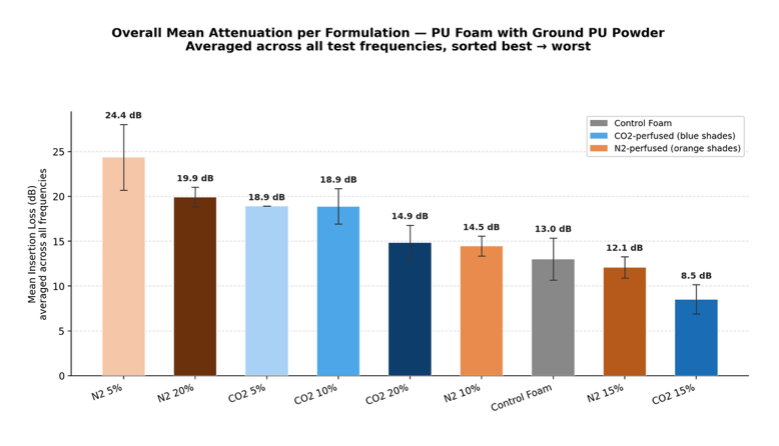
Mean insertion loss ranked best to worst (bottom)

Key results:

  • 15–35 dB insertion loss across 1,500–2,500 Hz
  • 24.4 dB mean IL for the best-performing formulation
  • Consistent broadband attenuation across all loadings

These results make the additive suitable for acoustic panels, insulation, equipment housings, and consumer products.

How the Additive Works

RoCo’s upcycled PU powder is produced by mechanically grinding foam while perfusing it with CO₂ or N₂. This process creates functionalized, micro‑porous particles that disperse evenly into the polyol.

Inside the foam, these particles create micro‑interfaces that:

  • Scatter and reflect incoming sound waves
  • Absorb energy through viscous friction
  • Convert acoustic energy into heat
  • Shift impact frequencies downward
  • Increase broadband attenuation

The mechanism is effective in both rigid and flexible PU systems.

Why This Matters

Traditional PU foams offer limited control over high‑frequency noise — the range where human hearing is most sensitive. By introducing impedance‑mismatch interfaces inside the foam, RoCo’s additive enables tunable NVH performance without requiring any changes to existing manufacturing lines.

This makes it a practical solution for OEMs seeking measurable acoustic improvements with minimal integration effort.

Sustainability Advantage

The powder is made from 100% recycled PU feedstock, supporting circularity and sustainability goals while reducing material costs.

Additional benefits include:

  • ~0.15 kWh/kg production energy
  • Negligible gate‑to‑gate environmental impact
  • Lower cost compared to virgin polyol
  • Supports Scope 3 emissions reporting

This positions the additive as both a performance enhancer and a sustainability enabler.

Limitations & Next Steps

The technology is currently in R&D and small‑batch production. Scale‑up is underway, with next steps including:

  • A‑weighted acoustic sweeps
  • Spectral centroid and decay‑constant analysis
  • OEM pilot integration

RoCo is actively preparing for pilot‑scale deployment.

Phosphonium-based ionic liquids (ILs) are a high-performance class of molten salts valued for their exceptional stability and tunability. By replacing the typical nitrogen-based cation (as in imidazolium or ammonium ILs) with a quaternary phosphonium cation, these ILs tends to have greater thermal and chemical robustnesslower volatility, and flexible polarity – a combination that lets them outperform more common ILs when it comes to thermal stability.  

 Below, we concisely explore what makes phosphonium ILs stand out, how they compare to other IL families, their key application areas, and a quick look at RoCo®’s top five phosphonium IL products with their properties and uses:


Why Phosphonium ILs Are Considered “High-Performance” 

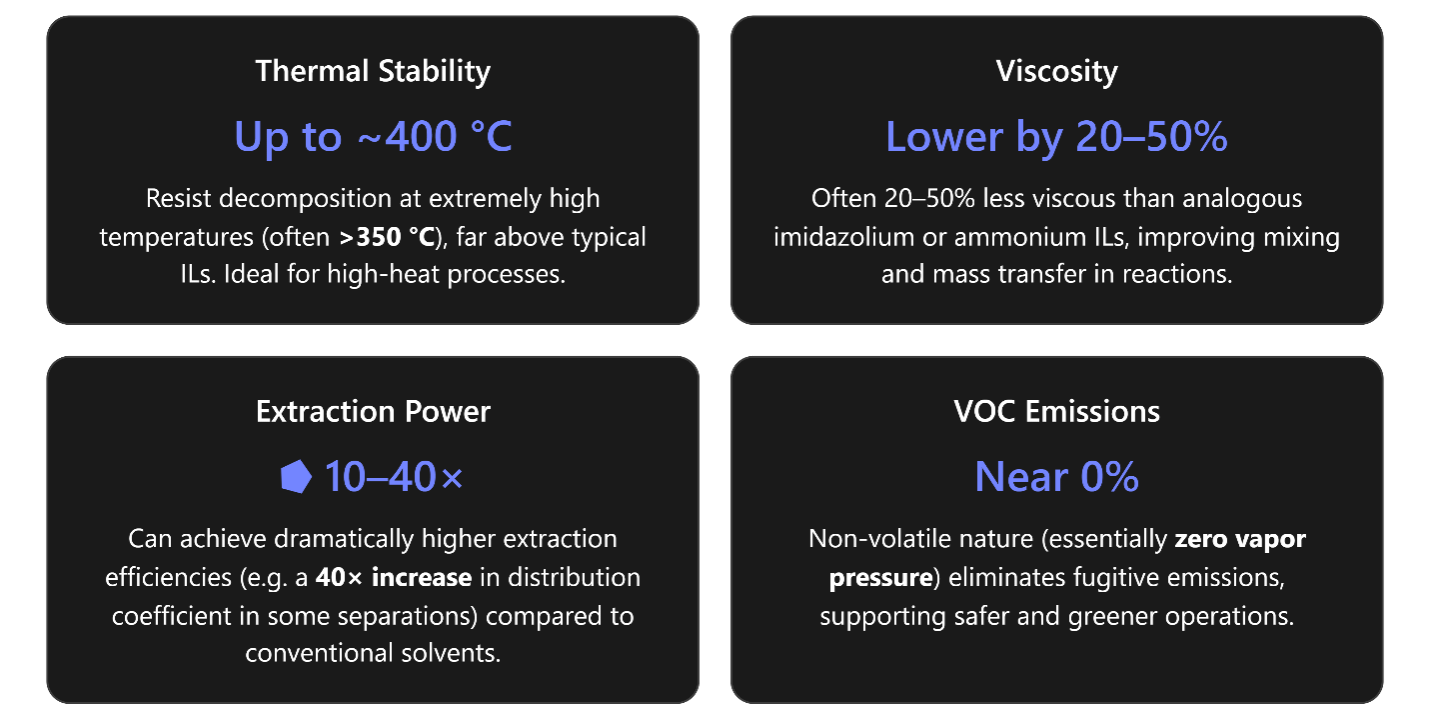
  • HigherStability: Phosphonium ILs are thermally and chemically sturdier than their imidazolium or ammonium counterparts. They lack acidic protons, so they withstand strongly basic conditions that would degrade imidazolium ILs (which have an acid-sensitive C2 hydrogen). In thermal terms, many phosphonium ILs remain intact well beyond 300 °C (with decomposition often around 350–400 °C in TGA tests), whereas comparable ammonium ILs break down at temperatures roughly 100 °C lower. This superior stability means phosphonium ILs can handle high-temperature reactions and prolonged operation without breaking apart or losing effectiveness.  
  • Tunable Polarity & Hydrophobicity: By choosing different alkyl chains on the phosphonium cation and pairing with various anions, we have fine-tuned phosphonium IL properties from polar (even hydrogen-bond donating) to highly hydrophobic. Notably, many common phosphonium ILs are more hydrophobic than imidazolium ILs. For example, phosphonium ILs with bulky organic anions (like phosphinates or fluorinated anions) are essentially immiscible with water, forming dedicated nonaqueous phases – perfect for biphasic systems such as liquid–liquid extractions or two-phase catalysis. On the other hand, phosphonium ILs with polar anions (e.g., methylsulfate) can dissolve polar substrates and even facilitate hydrogen-bonding interactions, acting as powerful solvents for biomass and polymers processing. This solvation is a key advantage: phosphonium ILs can be tailored to “like dissolves like” for a given task better than most solvent systems. 
  • Lower Viscosity, Better Fluidity: A practical edge of phosphonium ILs is their tendency toward lower viscosity compared to other ILs of similar molecular weight. The large tetraalkylphosphonium cation has a more diffuse charge and less hydrogen bonding, resulting in weaker intermolecular forces. In practice, a phosphonium IL can be significantly more fluid – often on the order of tens of centipoise less – than an imidazolium analog. This reduced viscosity eases stirring, pumping, and mass transport. In processes like extraction or when used as electrolytes, such improved fluidity can translate to faster diffusion and reaction rates, helping overcome what is sometimes a limitation of ILs (some ILs are so viscous they slow down mixing or separations). It’s worth noting that viscosity differences narrow at elevated temperatures (since all ILs become more fluid when heated), but at room temperature, the phosphonium ILs often hold this advantage.  
  • Wide Electrochemical Window & Conductivity: Phosphonium ILs also shine in electrochemical stability. They often support a wider electrochemical window (i.e., range of potentials without decomposition) than comparable ammonium ILs. For instance, with non-coordinating anions like PF₆⁻ or NTf₂⁻, a phosphonium IL can typically withstand ~5 V between its oxidation and reduction limits, enabling use in high-voltage electrochemical applications. Meanwhile, they exhibit decent ionic conductivity (often a few mS/cm at room temp. for neat ILs), and even higher when a mobile charge carrier (like Li⁺) is added, making them suitable as electrolyte media. However, it is important that using a phosphonium is not a guarantee that it will result in the ideal electrolyte composition. Importantly, they are non-flammable and remain liquid over a broad temperature range, improving the safety of batteries or supercapacitors that use them.  

Comparison: In summary, phosphonium ILs vs. imidazolium/ammonium ILsMore robust (thermally and chemically)often less viscoustunable from polar to hydrophobic, and wider electrochemical stability, at the slight expense of a larger cation that can sometimes mean lower equivalent conductivity per ion (due to size). They don’t engage in problematic side reactions (no carbene formation as in imidazoliums under strong base, no Hofmann elimination as in quaternary ammoniums). These distinctions make phosphonium ILs a very good candidate for extreme conditions and long-lasting performance where other ILs might falter.  


Key Applications and Sustainability Benefits 

Leveraging the above traits, phosphonium ILs have proven especially effective in several areas of chemistry and chemical engineering: 

  •  High-Temperature Catalysis: Because of their thermal stability, phosphonium ILs serve as excellent solvents or co-catalysts in high-temperature reactions – e.g. hydrothermal conversions, catalytic pyrolysis, or continuous flow processes that run at 200–250 °C. They won’t evaporate or decompose during the reaction, meaning they can provide a stable liquid medium for reactions that traditional solvents (or less stable ILs) simply couldn’t tolerate. Additionally, in phase-transfer catalysis scenarios, phosphonium ILs (such as tetrabutylphosphonium bromide) can replace classic ammonium salts (like Aliquat® 336), offering the same transfer of reagents between phases but with higher thermal durability. This allows reactions (like substitutions or condensations) to be driven faster and even to completion – studies have reported achieving 100% selectivity in certain O-alkylation reactions using a phosphonium IL as the PTC. Moreover, the catalyst/IL phase is easily recycled after reaction (as the IL remains as a separate phase), aligning with green chemistry practices.  
  • Separation Processes (Extraction): Phosphonium ILs are widely used in liquid-liquid extractions and separations for both inorganic and organic targets. Their hydrophobic members (like trihexyltetradecylphosphonium with appropriate anions) can efficiently extract metal ions (e.g. Co²⁺, Ni²⁺, rare earths) from aqueous feed into an IL phase, often achieving very high single-stage extraction percentages (near-complete removal of target metals). In one case, a specially formulated phosphonium IL achieved a distribution coefficient >40 for lactic acid extraction, versus ~1 using a conventional amine extractant – illustrating an orders-of-magnitude improvement in extraction power. These ILs enable processes like greener hydrometallurgy, where toxic volatile solvents are replaced by reusable IL phases. They also excel in extracting non-polar organics or pollutants from water, functioning as durable, non-volatile extractants that can be regenerated. Furthermore, because phosphonium ILs form biphasic systems readily (due to their hydrophobicity), they are a cornerstone in biphasic catalysis: a catalyst dissolved in the IL can facilitate a reaction in contact with a second phase (aqueous or organic), and then products can be separated by simple phase decanting. This simplifies purification and allows IL+catalyst reuse across cycles, cutting down waste.  
  •  Electrochemistry & Energy: In advanced batteries and supercapacitors, phosphonium ILs act as safe, high-performance electrolytes. Their wide electrochemical window and non-flammability add safety and stability to devices. For example, phosphonium ILs with anions like NTf₂⁻ are used as electrolytes for lithium-ion batteries capable of operating at elevated temperatures with less risk of thermal runaway. They have been used in metal plating, fuel cells, and electrochemical CO₂ reduction, where their stability allows reactions at extreme potentials or in reactive environments. A notable feature is the ability of some phosphonium ILs to stabilize reactive species: the abstract above notes that even superoxide (O₂⁻) can be generated and stabilized in certain ILs, which is normally very challenging and opens up novel chemistry for metal-air batteries or oxidation reactions. In summary, whenever an electrolyte or electrochemical medium is needed that won’t evaporate, won’t catch fire, and can sustain harsh conditions, phosphonium ILs are strong candidates.  
  • Materials Processing (Polymers & Biomass): The solvent capability of phosphonium ILs extends to dissolving otherwise stubborn solids. Biomass processing is a prime example: ILs like tributylmethylphosphonium methylsulfate can dissolve significant amounts of cellulose and lignin – up to a substantial weight percentage – thereby enabling the breakdown of plant matter into fine solutions for biofuel or biopolymer production. After dissolution, the cellulose can be precipitated or processed further, and the IL recycled (sometimes with anti-solvents or by phase changes). This has made phosphonium ILs key players in developing recyclable solvent systems for biomass pretreatment, replacing traditional, less efficient methods. In the realm of synthetic polymers, phosphonium ILs can act as plasticizers or processing aids: for instance, adding a small amount of a low-viscosity phosphonium IL can improve the flow of polymer melts or can imbue conductivity to polymer electrolytes (useful for solid-state batteries). They’ve even been formulated into lubricants and tribological fluids, taking advantage of their thermal stability and slipperiness to reduce friction in extreme conditions. Overall, the ability to dissolve, mobilize, or modify materials that are challenging for conventional solvents (like cellulose or highly non-polar polymers) is a standout benefit of phosphonium ILs in materials science.  
  • Sustainability Perks: Aside from performance, phosphonium ILs contribute to greener chemistry in several ways. Their near-zero vapor pressure means negligible VOC emissions – an IL can often replace a volatile organic solvent and thereby cut out a major source of air pollution and health hazard. This has a concrete impact: for example, an extraction or reaction using an IL emits virtually no fumes, whereas an equivalent process with hexane or dichloromethane would. Moreover, phosphonium ILs are typically recyclable; after use, they can be recovered (by distilling off products or by washing) and reused in subsequent runs. Industrial trials have shown that with proper setup, IL losses can be minimized and the same batch reused many times, dramatically reducing the total waste generation. They also enable energy-efficient process redesign: one can often carry out reactions and separations in ILs at mild conditions (because the IL can hold a catalyst or reagent in solution, or eliminate steps) that would otherwise require more energy or yield more waste. Finally, ongoing research indicates that many phosphonium ILs can be made with lower toxicity and biodegradability in mind (for instance, by selecting appropriate anions). All these factors position phosphonium ILs as tools for not only boosting performance but also for aligning with sustainability and green chemistry goals[link.springer.com] [cdn.intechopen.com] 


RoCo®’s Top 5 Phosphonium IL Products 

RoCo® is a leading supplier of high-purity ionic liquids, including a suite of phosphonium ILs. Here are five of our most popular phosphonium IL products, each with a glimpse of its technical profile and use cases: 

  1. Trihexyltetradecylphosphonium Bis(2,4,4trimethylpentyl)phosphinate (Product code: IN-0009-TG) – A hydrophobic, thermally sturdy IL (liquid up to ~350 °C+) often chosen for metal extraction and biphasic catalysis. Its large organic phosphinate anion imparts low water miscibility (great for separating aqueous/organic phases) and can coordinate with metals, enabling the extraction of ions like Co²⁺, Cu²⁺, etc., with very high efficiency. This IL (analogous to the commercial Cyphos® IL 104) has been used in continuous processes and even in the production of critical metals, thanks to its robustness. (Purity ≥90%.)  
  2. Trihexyltetradecylphosphonium Hexafluorophosphate (Product code: IN-0012-TG) – A general-purpose phosphonium IL with the non-coordinating PF₆⁻ anion. It is chemically inert and highly hydrophobic, with very low water uptake (virtually no water dissolves in it). This IL finds use in organic synthesis (as a non-polar solvent) and in electrochemistry – for example, as part of electrolyte formulations where its wide electrochemical window and stability improve performance. It’s also handy for the separation of non-polar compounds or for creating IL biphasic systems combined with water or polar solvents. (Purity ≥95%.)  
  1. Trihexyltetradecylphosphonium Dicyanamide (Product Code: IN-0010-TG) – Notable for its lower viscosity relative to other large phosphonium ILs (the dicyanamide [DCA] anion is small and reduces overall fluid resistance). This IL remains liquid at room temperature with moderate viscosity, improving handling. It’s widely used in polymer processing – for instance, dissolving or blending plastics and cellulose – and in lubricant research (providing an ionic medium with less drag for tribological testing). The DCA anion can also engage in coordination, making this IL useful in certain electrochemical contexts (e.g., as part of ionic conductive gels or in double-layer capacitors). (Purity ≥95%.)  
  2. Tributylmethylphosphonium Methylsulfate (Product Code: IN-0013-TG) – A polar, hydrogen-bond-capable IL that is solid just below room temperature (melting ~34 °C) but used in melt form. It has a relatively higher viscosity (~409 cP at 25 °C) due to strong ion pairing, but this correlates with excellent solvating power for biomass and polar substrates. It can dissolve substantial amounts of cellulose and is thus employed in biomass pretreatment for biofuels or biopolymer production. In catalysis, it serves as a reaction medium for acid-catalyzed and enzymatic reactions that require a polar environment,  often boosting yields by improving substrate solubility. (Purity ≥95%.)  
  1. Tetrabutylphosphonium Bromide (Product Code: IN-0014-TG) – A classic quaternary phosphonium salt, typically shipped as a solid (mp ≈100 °C) that forms an IL when melted or dissolved. It’s a versatile phase-transfer catalyst, frequently used to accelerate reactions where anions need to move between aqueous and organic phases (e.g., halogen exchange, Williamson ether synthesis). Compared to analogous ammonium bromides, it offers higher thermal stability and can be recycled more times. Additionally, this salt is a common precursor for other ILs: through metathesis, its bromide can be exchanged with other anions to synthesize custom phosphonium ILs. (Purity ≥98%.)  


Summary Table – Key Properties of RoCo®’s Top 5 Phosphonium ILs: 

Phosphonium IL (Code)  Key Properties  Typical Applications 
Trihexyltetradecylphosphonium
bis(2,4,4-trimethylpentyl)phosphinate
(IN-0009-TG) 
Hydrophobicity: Extremely high (water immiscible)
Thermal stability: ~350 °C+ 
Coordinating anion: Yes (phosphinate) 
– Metal extraction (e.g. Co, Ni, rare-earth recovery) 
– Biphasic catalysis (IL phase for catalyst, easy product separation) 
Trihexyltetradecylphosphonium
hexafluorophosphate
(IN-0012-TG) 
Hydrophobicity: High (very low water uptake) 
Electrochemical window: Wide Viscosity: Moderate (less than imidazolium PF₆ analog) 
– Organic solvent replacement (non-volatile medium for organic reactions)
– Electrolyte component (stable, non-flammable electrolyte for batteries/supercapacitors) 
– Hydrophobic separations (extracting non-polar compounds) 
Trihexyltetradecylphosphonium
dicyanamide
(IN-0010-TG
Viscosity: Lower than other P₄₄₄₁₄ ILs (more fluid) 
Conductivity: Good ionic mobility
Anion functionality: DCA offers mild coordination 
– Polymer & biomass dissolution (e.g. processing cellulose, plastics blends) 
– Lubricants & heat-transfer fluids (ionic medium for high-temp lubrication studies)
– Electrochemical uses (ionic liquid gels, capacitors requiring low-viscosity IL) 
Tributylmethylphosphonium
methylsulfate
(IN-0013-TG
Polarity: High (protic IL with –SO₄CH₃)
Dissolution power: Dissolves polar biopolymers (cellulose, etc.) 
Viscosity: 409 cP @25 °C (melts at 34 °C) 
– Biomass pretreatment (dissolving cellulose & lignin for biofuel production) 
– Polar reaction medium (supports acid catalysts, enzymatic reactions in IL)
– Ion exchange resin (used in supported IL phases for separations) 
Tetrabutylphosphonium
bromide
(IN-0014-TG) 
Phase-transfer catalyst (PTC): Yes (classic PTC bromide)
Stability: High (no Hofmann elimination) 
Melting point: ~100 °C (usable as molten salt) 
– Phase-transfer catalysis (facilitates SN2 and other biphasic reactions, often faster rates than without PTC) 
– IL synthesis precursor (source for P⁺₄₄₄₄ cation in making other ionic liquids via anion exchange)
– Catalyst recycling (immobilizing catalysts in IL phase for reuse) 

Each of these ILs comes with a Certificate of Analysis (CoA), and a Technical datasheet is available.  

In conclusion, phosphonium ionic liquids offer a compelling blend of performance (with their stability, versatility, and efficiency gains) and sustainability (through reduced emissions and reusability). They exemplify how innovative chemistry can create solvents that meet the challenges of modern R&D and industrial processes. As you consider solvents and reaction media for your next project, especially one aiming for high impact and green credentials, phosphonium ILs – including the top picks from RoCo® – should be high on your list of options. These liquids are not just alternatives; in many cases, they are enablers of new chemistry, allowing processes to operate in ways not possible before. That is why phosphonium ionic liquids have earned their reputation as high-performance materials in the push toward cleaner, more efficient chemical technologies.  

References: 

Applications of phosphonium-based ionic liquids in chemical processes | Journal of the Iranian Chemical Society | Springer Nature Link 

InTechQuaternary_ammonium_and_phosphonium_ionic_liquids_in_chemical_and_environmental_engineering.pdf 

Explore our full range of phosphonium ionic liquids and buy ionic liquids online from a trusted ionic liquid supplier with a proven track record in government, industrial, and institutional deliveries.

RoCo’s Phosphonium Ionic Liquids

Choline is a biologically essential compound classified as a quaternary ammonium alcohol. It plays a critical role in cellular function, particularly in the synthesis of phospholipids (e.g., phosphatidylcholine), neurotransmitters (e.g., acetylcholine), and methylation pathways. 

  • In plants, choline is biosynthesized from the amino acid serine via ethanolamine intermediates and methylation steps. 
  • In animals, it is found in tissues such as the liver and brain and can be obtained from dietary sources or synthesized endogenously. 
  • Structurally, choline consists of a positively charged nitrogen atom bonded to three methyl groups and a hydroxyethyl chain: (CH₃)₃NCH₂CH₂OH. 

Choline is often understood as choline chloride, particularly in general or biochemical contexts, where chloride is seen as the standard accompanying anion. However, in the realm of ionic liquids, “choline” specifically refers to the choline cation. In this area, the choline cation is paired with various anions—such as acetate, lactate, formate, and bis(trifluoromethylsulfonyl)imide—to form different choline-based ionic liquids. These combinations are chosen to modify properties like viscosity, electrical conductivity, and biodegradability for targeted uses. 

Why Choline Ionic Liquids Are Important 

Choline-based ionic liquids (ILs) are formed by pairing the choline cation with a range of anions to tune properties such as: 

  • Hydrophilicity: Most choline ILs are water-soluble, enabling use in aqueous-phase reactions and formulations. 
  • Thermal stability: Many exhibit melting points above 150°C, suitable for high-temperature synthesis. 
  • Conductivity: Tunable ionic conductivity makes them suitable for electrochemical applications. 
  • Hydrogen bonding: Strong donor/acceptor profiles support solvation and catalytic activity. 
  • Pairing choline with citrate, lactate, or long-chain fatty acids creates ILs that are biocompatible and useful for drug solubilization, targeted delivery, and nutraceuticals. 

These ILs are valued for their low toxicity, biocompatibility, and formulation versatility, making them ideal for sensitive and performance-driven systems. 

Key Applications 

  • Electrochemistry: As electrolytes in low-voltage systems and metal recovery processes   
  • Biomaterials: In drug delivery, tissue engineering, and bio lubricants   
  • Catalysis and synthesis: As solvents or co-catalysts in aqueous and mixed-phase reactions   
  • Formulation science: In emulsifiers, buffers, and nutrient-based systems   
  • Drug delivery: Choline based ionic liquids are seeing significant uptake as a drug delivery carrier.  

As a trusted ionic liquid supplier, RoCo® delivers researchgrade ionic liquids that meet the highest purity and compliance standards — available to buy ionic liquids online for fast, reliable delivery. 

 Top Four Choline Ionic Liquids from RoCo® 

  • [CHOL][DHP] – Choline Dihydrogen Phosphate   

A high-purity ionic liquid used in electrochemical synthesis, buffering systems, and biocompatible formulations. Its phosphate anion contributes to excellent thermal stability and pKa buffering near physiological pH, making it suitable for biomedical solvents and nucleic acid processing.   

Available in >98% purity, refer to IL-0042-HP 

  • [CHOL][HEX] – Choline Hexanoate 

A medium-chain carboxylate IL used in organic synthesis, membrane interaction studies, and biomass depolymerization. It has been studied for bacterial lysis, DNA extraction, and as a component in water-based bio-lubricants.   

Available in >97% purity, refer to IL-0351-HP 

  • [CHOL][OAC] – Choline Acetate   

A is a polar, hydrogen-bonding ionic liquid used in bioethanol processing, catalysis, and electrochemical devices. Its strong solvation properties and high polarity make it ideal for aqueous formulations and phase behavior studies.    

Available in >98% purity, refer to IL-0322-HP 

  • [CHOL][BTA] Choline bis(trifluoromethylsulfonyl)imide   

A hydrophobic ionic liquid with low viscosity and excellent electrochemical stability. It is commonly used in electrochemical devices, separations, and research on advanced materials, particularly where non-aqueous, low-volatility systems are required. 

Available in >99% purity, refer to IL-0110-HP

Why Choose RoCo as Your Ionic Liquid Supplier 

At RoCo®, we’re committed to providing high-quality materials that meet the demands of advanced scientific and industrial applications.  

When you buy ionic liquids online from RoCo®, you’re partnering with a supplier trusted by leading research institutions and government agencies.  

Choline-based ionic liquids are versatile functional materials that drive innovation in electrochemistry, formulation science, and biocompatible technologies. Their tunable polarity, low toxicity, and compatibility with aqueous systems make them ideal for applications such as metal recovery, catalysis, drug delivery, and the development of bio-based materials.  

Explore our full range of Choline-based ionic liquids and buy ionic liquids online from a trusted supplier with a proven track record in government, industrial, and institutional deliveries. 

Imidazolium ionic liquids are transforming the way chemists approach sustainable synthesis, energy storage, and advanced materials. Built on the imidazole ring- a five-membered aromatic heterocycle made of three carbon atoms and two non-adjacent nitrogen atoms, these salts remain liquid at or near room temperature, offering thermal stability, low volatility, and tunable properties that make them indispensable in both research and industrial applications.   

As a trusted ionic liquid supplier, RoCo delivers researchgrade ionic liquids that meet the highest purity and compliance standards — available to buy ionic liquids online for fast, reliable delivery. 

 Why Imidazolium Ionic Liquids Are Unique 

  • Tunable structure – Adjust alkyl chains and anions to control viscosity, polarity, and solubility.   
  • Thermal & chemical stability – Many withstand temperatures above 300°C.   
  • Wide electrochemical window – Ideal for batteries, supercapacitors, and electroplating.   
  • Low environmental impact – Negligible vapor pressure reduces VOC emissions.   

These features make imidazolium ionic liquids a cornerstone in green chemistry and advanced materials research. 

Key Applications 

  • Catalysis – As solvents or cocatalysts in organic synthesis.   
  • Electrochemistry – In lithiumion batteries, fuel cells, and supercapacitors.   
  • Biomass processing – Dissolving cellulose and lignin for biofuels and biopolymers.   
  • Gas capture – Selective CO₂ absorption for carbon capture technologies.   

Whether you’re in academia, government R&D, or industry, researchgrade ionic liquids from RoCo can help you achieve reproducible, highperformance results. 

Four Popular Imidazolium Ionic Liquids from RoCo®  

At RoCo, we supply highpurity imidazolium ionic liquids with Certificates of Analysis (CoA) and Safety Data Sheets (SDS). Here are four of our most indemand products: 

  • [BMIM][PF₆] – 1Butyl3methylimidazolium Hexafluorophosphate
    • A hydrophobic imidazolium ionic liquid with excellent electrochemical stability, perfect for twophase catalysis and electrochemical sensors.
    • Available in two purities, for high purity of >99%, refer to IL-0011-HP, and for ultra-high purity of >99.5%, refer to IL-0011-UP 
  • [EMIM][OAc] – 1Ethyl3methylimidazolium Acetate
    • Exceptional at dissolving cellulose, making it a goto researchgrade ionic liquid for biomass pretreatment and polymer research.
    • Available in two purities, for purity of >95%, refer to IL-0189-TG, and for high purity of >98%, refer to IL-0189-HP.   
  • [BMIM][Cl] – 1Butyl3methylimidazolium Chloride 
    • A versatile imidazolium ionic liquid for cellulose dissolution, metal extraction, and synthetic chemistry.   
    • Available in >99% purity, refer to IL-0014-HP 
  • [HMIM][Tf₂N] – 1Hexyl3methylimidazolium Bis(trifluoromethylsulfonyl)imide 
    • Hydrophobic, lowviscosity, and thermally stable — ideal for lubricants and advanced electrochemical devices.  
    • Available in two purities, for high purity of >99%, refer to IL-0098-HP, and for ultra-high purity of >99.5%, refer to IL-0098-UP.  


 Why Choose RoCo® as Your Ionic Liquid Supplier 

At RoCo, we’re committed to providing high-quality materials that meet the demands of advanced scientific and industrial applications.  

Explore our full range of imidazolium ionic liquids and buy ionic liquids online from a trusted ionic liquid supplier with a proven track record in government, industrial, and institutional deliveries.   

RoCo’s imidazolium Ionic Liquids   

Ionic liquids (ILs), a class of salts that remain liquid at or near room temperature, have garnered significant attention due to their unique properties, including low volatility, high thermal stability, and tunable viscosity. These properties make them essential in various industrial applications, including electrochemical systems, green chemistry, and catalysis.

One of the most important physical properties of ILs is viscosity, which can significantly influence their performance in processes such as reaction kinetics, energy transfer, and mass transport. This blog explores how to estimate the viscosity of ionic liquids based on their chemical structure and molecular interactions.

Viscosity: What Does It Mean for Ionic Liquids and Beyond?


When talking about liquids, viscosity is the property that tells us how thick or runny a fluid is—essentially, how easily it flows.

In the world of chemistry and industry, viscosity matters everywhere. For hydrocarbons, it affects how fuels are transported or how well lubricants perform. In organic solvents, viscosity determines how efficiently they dissolve materials or separate mixtures.

Ionic liquids, however, are a special case. Unlike traditional liquids made of neutral molecules, ionic liquids are composed entirely of charged particles (ions). This gives them a distinctively higher viscosity than most hydrocarbons or organic solvents. But that’s not a drawback—in fact, it’s part of what makes them so interesting! Ionic liquids can dissolve a wide variety of compounds, including both hydrocarbons and organic solvents, acting as a versatile medium for chemical reactions and separations.


Understanding and controlling the viscosity of ionic liquids—and how they interact with other liquids—is crucial for optimizing everything from green chemistry and energy storage to cutting-edge material synthesis. Whether you’re developing new catalysts, designing safer batteries, or creating more sustainable industrial processes, a grasp of viscosity is key to unlocking the full potential of ionic liquids.

Key Factors Influencing the Viscosity of Ionic Liquids

Viscosity in ionic liquids is influenced by the size, shape, and interaction strength of their ions. Let’s break down the main factors:

  1. Cation and Anion Structure

  • Cation Size and Shape:
    The cation plays a significant role in determining viscosity. Larger, more bulky cations, such as phosphonium or imidazolium-based ions, typically increase viscosity because they cause stronger intermolecular interactions and steric hindrance. In contrast, smaller, more compact cations (like methylimidazolium) result in lower viscosity.
  • Anion Type:
    The anion’s size, charge density, and polarizability also affect viscosity. For instance, TFSI and BF₄ anions, being large and highly polarizable, interact more strongly with the cations, raising viscosity. Smaller, less polarizable anions like chloride (Cl) result in lower viscosity.
  1. Intermolecular Forces

Ionic liquids possess several types of intermolecular forces that contribute to their viscosity:

  • Electrostatic Interactions:
    The ionic nature of ILs means that electrostatic attractions between cations and anions play a major role in their resistance to flow. Strong ionic interactions lead to higher viscosity.
  • Hydrogen Bonding:
    Many ILs contain functional groups such as hydroxyl (-OH) or amine (-NH₂) groups, which form hydrogen bonds. These bonds increase molecular cohesion, thus raising the viscosity.
  • π-Stacking and Van der Waals Forces:
    Aromatic cations (e.g., imidazolium, pyridinium) experience π-π interactions or π-stacking, which contribute to higher viscosity due to their rigid, planar structures and additional intermolecular interactions.
  1. Temperature Sensitivity

The viscosity of ionic liquids is temperature-dependent:

  • Decrease with Temperature:
    As the temperature rises, the thermal energy disrupts intermolecular forces, leading to a decrease in viscosity. However, this decrease may be non-linear and can be less pronounced compared to conventional liquids.
  • Shear-Thinning Behavior:
    Many ILs exhibit shear-thinning behavior, meaning their viscosity decreases when subjected to high shear rates (such as in mixing or pumping). This property is valuable in industrial applications where viscosity needs to be controlled under varying flow conditions.

Estimating Viscosity from Chemical Formulas

While direct measurement of viscosity is the most reliable method, we can estimate the viscosity of ionic liquids based on their chemical structure and molecular interactions. Here’s a general approach:

  1. Molecular Size and Weight
  • Larger Ions:
    Ionic liquids with larger ions (e.g., bulky phosphonium-based cations) tend to have higher viscosity due to increased steric hindrance and stronger intermolecular interactions.
  • Small Ions:
    ILs with smaller, more compact ions (e.g., methylimidazolium with TFSI) typically exhibit lower viscosity due to weaker ion-pairing.
  1. Functional Groups and Interactions

  • Hydrogen Bonding:
    If an IL contains functional groups capable of hydrogen bonding (e.g., hydroxyl (-OH), amine (-NH₂)), you can expect higher viscosity. The strength and number of these bonds contribute to increased intermolecular cohesion.
  • Ion Pairing:
    The degree of ion pairing also affects viscosity. Strongly paired ions (due to electrostatic forces) result in higher viscosity.

Measuring Viscosity in Ionic Liquids

Viscosity in ionic liquids can be measured using various techniques:

  • Capillary Viscometers:
    For kinematic viscosity, capillary viscometers measure the time taken for a liquid to flow through a narrow tube. This method is widely used for low-viscosity samples.
  • Rotational Viscometers:
    These instruments measure dynamic viscosity by applying shear stress and measuring the resulting resistance. This method is ideal for highly viscous or shear-thinning fluids.
  • Falling Ball Viscometers:
    A ball is dropped through the IL, and the time it takes to fall is used to calculate viscosity. This method is most effective for low-viscosity, transparent liquids.
  • Microfluidic Rheometers:
    Used for high-precision measurements, these devices offer fine control over shear rates and temperature, making them suitable for advanced manufacturing and ionic liquid development.

Applications of Ionic Liquids with Tailored Viscosity

The ability to tune the viscosity of ionic liquids makes them ideal for numerous applications, such as:

  • Electrochemical Devices:
    Ionic liquids are used in batteries, capacitors, and fuel cells, where low viscosity helps enhance ionic conductivity and energy storage capacity.
  • Catalysis:
    ILs are popular solvents in catalytic reactions, where viscosity influences reaction rates and selectivity. Tunable viscosity enables precise control over these reactions.
  • Green Chemistry:
    Used in solvent-free processes, ILs with controlled viscosity provide environmentally friendly alternatives to volatile organic compounds (VOCs) in chemical manufacturing.
  • Lubrication:
    ILs with high viscosity can be used as advanced lubricants, offering superior performance in high-temperature, high-stress environments.

Conclusion: The Role of Viscosity in Ionic Liquids for Industrial Applications

Viscosity is one of the most critical properties of ionic liquids that influence their performance in chemical processes, energy systems, and material synthesis. Understanding how to estimate and control viscosity based on molecular structure and intermolecular interactions allows for the precise design of ionic liquids suited for specific applications.

By leveraging the tunable viscosity of ILs, industries can improve reaction efficiency, enhance safety, and foster the development of sustainable manufacturing technologies.

In a bold move toward sustainable innovation, RoCo® has announced the spin-off of Singularity Polymers, a company poised to transform the materials industry with its cutting-edge ionic liquid technology. This strategic decision, coupled with recent funding from Carnegie Mellon University’s Tartan Entrepreneurs Fund, marks a significant milestone in advancing high-performance, eco-friendly materials for a range of industrial applications.

The Genesis of Singularity Polymers

RoCo® is a leader in harnessing ionic liquids and ionic polymer additives, and has long been at the forefront of sustainable manufacturing and chemical processing. The spin-off of Singularity Polymers is a natural evolution of RoCo®’s mission to drive industry transformation through innovative material solutions. By focusing on a single material with exceptional barrier properties, Singularity Polymers aims to address critical challenges in packaging, energy, and industrial sectors, where durability and sustainability are paramount.
The technology at the heart of Singularity Polymers stems from RoCo®s proprietary ionic liquid innovations. Ionic liquids, known for their low volatility and high stability, enable the creation of materials with superior performance characteristics. This spin-off allows Singularity Polymers to specialize in developing a single, high-barrier material that outperforms traditional alternatives, offering improved resistance to gases, moisture, and other environmental factors.

Leadership Driving the Vision

Singularity Polymers is led by a formidable team of experts, combining academic rigor, industry experience, and entrepreneurial acumen. The leadership includes:

  • Bill Belias, a packaging industry veteran and the CEO of Singularity Polymers. Mr. Belias brings extensive experience, having developed SoFresh, a notable innovation in the packaging sector. His leadership is critical in steering the company toward market success.
  • Dr. Hunaid Nulwala, a pioneer in ionic liquid technology, whose research has been instrumental in developing the core innovations behind Singularity Polymers’ high-barrier material.
  • Prof. Carlos Diaz, an esteemed academic whose expertise in material science and engineering bolsters the company’s technical foundation.
    This trio’s combined expertise ensures that Singularity Polymers is well-equipped to translate cutting-edge research into practical, industry-changing solutions.

Tartan Entrepreneurs Fund: Fueling Innovation

The spin-off has been bolstered by funding from the Tartan Entrepreneurs Fund, an initiative by Carnegie Mellon University’s Swartz Center for Entrepreneurship. This financial support underscores the potential of Singularity Polymers to disrupt the materials market. The Tartan Entrepreneurs Fund is designed to empower early-stage ventures with the resources needed to scale, and its investment in Singularity Polymers reflects confidence in the company’s vision and technological prowess.
While specific details about the funding amount remain undisclosed, the backing from such a prestigious institution highlights the commercial and environmental promise of Singularity Polymers’ technology. This investment will likely accelerate research and development, enabling the company to refine its material and explore new applications.

Technology: A Game-Changer in Barrier Properties

At the core of Singularity Polymers’ innovation is a single material engineered with high barrier properties, achieved through the integration of RoCo®’s ionic liquid technology. Unlike conventional materials that rely on complex layering or additives to achieve barrier performance, Singularity Polymers’ solution is elegantly simple yet highly effective. The material’s enhanced barrier properties make it ideal for applications such as:

  • Sustainable Packaging: Reducing food waste and extending shelf life by preventing oxygen and moisture ingress.
  • Energy Storage: Improving the longevity and efficiency of batteries and fuel cells.
  • Industrial Applications: Enhancing the durability of coatings and membranes in harsh environments.
  • The use of ionic liquids allows Singularity Polymers to create a material that is not only high-performing but also aligns with the growing demand for sustainable solutions. Ionic liquids are recognized as a cornerstone of green chemistry, offering a low environmental footprint compared to traditional solvents and additives.

Why This Matters: A Critical Perspective

The spin-off of Singularity Polymers raises important questions about the future of material science and sustainability. While the promise of a single, high-barrier material is exciting, it’s worth examining the challenges ahead. Scaling ionic liquid-based technologies can be costly, and regulatory hurdles may slow adoption in certain industries. Additionally, the environmental benefits of ionic liquids depend on their lifecycle management—how will Singularity Polymers ensure responsible production and disposal?
Moreover, the reliance on a single material could limit flexibility in addressing diverse market needs. How will Singularity Polymers balance specialization with adaptability? The answers to these questions will determine the long-term success of this venture.

Looking Ahead

The spin-off of Singularity Polymers represents a significant step forward for RoCo® and the broader materials industry. With a stellar leadership team, the support of the Tartan Entrepreneurs Fund, and RoCo®’s proven expertise in ionic liquid technology, Singularity Polymers is well-positioned to deliver a material that redefines performance and sustainability standards.
As the company moves forward, it will need to navigate the complexities of market adoption, regulatory compliance, and environmental responsibility. If successful, Singularity Polymers could set a new benchmark for what’s possible in material science, proving that innovation and sustainability can go hand in hand.
Learn more about how ionic liquids can innovate materials science by visiting RoCo. To learn about the Tartan Entrepreneurs Fund, check out CMU’s Swartz Center for Entrepreneurship, and to learn more about Singularity, please visit www.Singularity Polymers.com

How Ionic Liquids Are Revolutionizing Sustainability in the U.S. Market

Ionic liquids are gaining traction as versatile, eco-friendly alternatives to conventional solvents. Their unique properties—low volatility, high thermal stability, and tunable solubility—make them ideal for applications in energy storage, catalysis, pharmaceuticals, and advanced manufacturing. As the U.S. market embraces sustainability and technological advancements, ionic liquids are poised to play a crucial role in shaping the future of multiple industries.

Market Growth and Trends

The U.S. ionic liquids market was valued at $882 million in 2023 and is projected to exceed $2.8 billion by 2032. This growth is driven by increasing demand for green chemistry solutions, stringent enviro nmental regulations, and advancements in renewable energy technologies. Companies are investing in research to enhance ionic liquid formulations for carbon capture, battery technology, and industrial separations.

Key Applications in the U.S.

  • Energy Storage & Batteries – Ionic liquids are being integrated into next-generation lithium-sulfur and solid-state batteries, improving efficiency and longevity.
  • Pharmaceuticals & Biotechnology – Their ability to dissolve complex organic compounds makes them valuable in drug formulation and bio-refineries.
  • Catalysis & Chemical Processing – Used as solvents in carbon capture and sequestration (CCS), ionic liquids help industries reduce greenhouse gas emissions.
  • Electronics & Advanced Manufacturing – Their high ionic conductivity supports applications in fuel cells, electric motors, and semiconductor processing.
  • Lubricants & Anti-Wear Coatings – Ionic liquids are being explored as high-performance lubricants due to their excellent thermal stability and low volatility, reducing friction in industrial machinery and aerospace components.
  • Gas Separation & Carbon Capture – Their tunable solubility makes them effective in CO₂ capture and gas separation technologies, helping industries meet environmental regulations.
  • Electroplating & Corrosion Protection – Used in electrodeposition processes, ionic liquids enable efficient metal plating while minimizing hazardous waste.
  • Biomass Processing & Biofuels – Ionic liquids facilitate efficient lignocellulose breakdown, improving biofuel production from agricultural waste.
  • Water Treatment & Desalination – Their ability to selectively dissolve contaminants makes them valuable in wastewater treatment and desalination processes.
  • Recycling & Waste Recovery – Ionic liquids are being used to dissolve and separate valuable metals from electronic waste, improving material recovery and reducing environmental impact.
  • Rare Earth Element Extraction – Ionic liquids enhance selective separation and recovery of rare earth elements, offering a more sustainable alternative to traditional solvent-based extraction methods.

Ionic Liquids Classes by RoCo® 

RoCo® is a leading Supplier and manufacturer of high-performance ionic liquids for industrial and research applications. Some of their notable class include:

– Imidazolium-Based Ionic Liquids – Widely used in solvents, catalysis, and electrochemical applications due to their tunable properties and high ionic conductivity.

Pyrrolidinium Ionic Liquids – Preferred for battery electrolytes, fuel cells, and supercapacitors due to their remarkable electrochemical stability.

Piperidinium Ionic Liquids – Known for their chemical and thermal stability, making them ideal for energy storage and high-performance lubricants.

Ammonium Ionic Liquids – Cost-effective and versatile, used in catalysis, electroplating, and green chemistry.

Phosphonium Ionic Liquids – Provide excellent thermal and oxidative stability, making them ideal for heat transfer fluids, lubricants, and polymer processing.

Sulfonium Ionic Liquids – Highly resistant to oxidation and ideal for high-temperature uses, green solvents, and battery electrolytes. Their structure can be tailored for specific industrial needs.

Triazolium Ionic Liquids – With a five-membered triazole ring, these offer high electrochemical and thermal stability. They are used in catalysis, organic synthesis, and advanced electrochemical devices due to their customizable properties.

Challenges and Future Outlook

Despite their advantages, high production costs and regulatory barriers remain hurdles for widespread adoption. However, ongoing research and federal funding are driving innovation, making ionic liquids more economically viable. As industries prioritize sustainability and efficiency, the U.S. market is expected to see rapid advancements in ionic liquid applications.
Ionic liquids are revolutionizing multiple sectors in the U.S., offering sustainable solutions for energy, healthcare, and industrial processes. With continued investment and technological breakthroughs, they are set to become a cornerstone of green chemistry and advanced manufacturing.

It’s no secret that plastic waste is a massive problem in the United States. Each year, we generate over 40 million tons of plastic waste—yet, according to a 2022 Greenpeace report, less than 6% of it is ever recycled into something new. Meanwhile, the demand for post-consumer recycled (PCR) plastic is skyrocketing, with forecasts predicting it will double by 2032. If the demand exists, why aren’t we recycling more?

Overburdened Infrastructure – Underutilized Resources

One of the biggest barriers to solving the plastic problem isn’t just awareness or willingness—it’s infrastructure. Despite the clear need, large-scale and advanced recycling infrastructure projects are often delayed, underfunded, or altogether cancelled (as was recently the case for Erie’s International Recycling Group’s advanced materials recovery facility, or MRF). Smaller and more rural MRFs (which represent over two-thirds of America’s materials recovery infrastructure according to industry group, Resource Recycling) overwhelmingly sort manually hand-picking recyclables-and operate at less than 60% capacity on average. Ultimately, the value of recycled plastic is outweighed by the (rising) costs of sorting, labor, transportation, brokering, and processing.
On the subject of processing, even if your plastic waste is properly sorted and baled, our processing infrastructure is too overburdened to keep up. Our domestic PCR plastic processing capacity—to grind, clean, and re-extrude that waste into valuable manufacturing source material—is estimated to have the capacity to process only 20% of post-consumer PET, 10% of HDPE, and negligible quantities of other resins.
Transportation is a particular burden in this supply chain. A 2019 paper published by the International Journal of Engineering Sciences and Research Technology that evaluated recycling stream process flows estimated that in order to recycle 1.4 tons of polypropylene in the United States, we emit around 10 tons of CO2 just from transporting materials between facilities. The CO2 emissions reduction of recycling PP is still over three times lower than the production of virgin material, but the rising costs of trucking make these efforts economically untenable.
Recycling plastic, particularly post-consumer waste, is a deeply complex challenge that currently relies on intricate supply chains with many stakeholders. This cross-sectoral coordination is rarely streamlined, and the cost of participation almost universally outweighs the return, especially in America’s many small and rural communities.

New Paradigms in Plastic Recycling

But there is a smarter, more efficient path for reclaiming plastic: right-sized, automated, modular, and vertically-integrated plastic sorting and processing systems.
These systems offer a radical shift in how we think about recycling infrastructure—one that favors distributed processing and manufacturing and places an emphasis on generating valuable outputs at the point of generation. By installing smaller (but more frequent), intelligent recycling and processing units closer to where waste is generated (think commercial centers, manufacturing facilities, or neighborhoods), and by focusing on modular solutions that can adapt to those waste streams, we can significantly reduce the burdens of transportation and labor. Simultaneously, we can increase the consistency and value of PCR plastic through AI-driven sensing and capturing waste streams before the effects of entropy set in.

structureAdvanced sorting, tracing, and processing technologies can enable this new economy for plastic waste. Focusing on plastic waste-streams and leveraging artificial intelligence allows lower-cost sensing technologies to autonomously sort waste streams more efficiently. Consolidating sorting and processing into single facilities eliminates costly and wasteful intermediary steps and enables tracing from waste to product, with obvious benefits to manufacturers that struggle to find high-quality PCR plastic compatible with their current manufacturing processes.

A Greener Future

By shifting from a bloated, centralized model to a scaled and focused network of intelligent micro-recyclers, we unlock new business models that are not only more sustainable but also financially viable. Ultimately, the future of plastic recycling won’t be won with more trucks or bigger factories—it’ll be won with smarter, leaner, and more data-driven technology.

Author Bio

Georgia Crowther is a robotics engineer with experience as a founding member of several high-tech startups and is the founder and CEO of Reclamation Factory. Her personal experience struggling to find diversion streams for post-industrial plastic waste and sourcing recycled plastic for advanced manufacturing has driven her passion for finding recycling solutions. Georgia has a Master’s in Robotic Systems Development from Carnegie Mellon University and a Bachelor’s in Mechanical Engineering from Cornell University.