Choosing the right ionic liquid electrolyte can make or break a battery R&D project. This guide walks through the four properties that matter most, how they apply whether you are using ionic liquids as full electrolytes or as SEI-forming additives, and why molecular design is the key to unlocking the next generation of high-conductivity IL systems.
Key takeaways
- Ionic liquid electrolytes are non-flammable, thermally stable beyond 300 °C, and stable across 5–6 V — a genuine step change over carbonate systems.
- You do not have to swap the whole electrolyte. At 0.5–10 wt%, ionic liquids act as SEI-forming additives with no viscosity penalty.
- Conductivity is governed by ionicity, not viscosity alone, so it is a molecular design lever rather than a fixed limit.
- Match the ionic liquid family to your cell chemistry across four properties: stability window, conductivity, thermal safety, and SEI behavior.
Why Ionic Liquid Electrolytes Are the Future of Batteries
Carbonate electrolytes have a ceiling. They are flammable, they decompose above ~4.5 V, and they generate gas during thermal runaway. Three decades of additive optimization have pushed that ceiling higher, but the fundamental chemistry has not changed: you are still dissolving a lithium salt in a volatile organic solvent.
Ionic liquids remove the solvent entirely. A room-temperature ionic liquid is a salt that functions as its own medium: non-flammable, thermally stable beyond 300 °C, electrochemically stable across windows of up to 5–6 V, and with effectively zero vapor pressure. That combination is not incremental. It changes what a battery cell can do.
The conventional objection is viscosity. Neat ionic liquid electrolytes are more viscous than carbonates, and their room-temperature conductivities (0.5–10 mS/cm) sit below the 10–15 mS/cm of standard LP30. This is a real trade-off, but it is not the barrier it once appeared to be, for two reasons.
First, ionic liquids do not have to replace the entire electrolyte to deliver value. At low loadings (0.5–10 wt%) in conventional carbonate systems, ionic liquids function as SEI-forming additives. The mechanism is preferential decomposition: the ionic liquid anion (particularly FSI⁻) reduces at slightly higher potentials than the bulk solvent, incorporating into the solid-electrolyte interphase early and templating a thinner, more fluorine-rich, and more ionically conductive film. This gives battery manufacturers the interphase benefits of ionic liquid chemistry without re-engineering filling processes or accepting a viscosity penalty.
Second, and more fundamentally, conductivity in ionic liquids is not governed by viscosity alone. It depends on ionicity: the fraction of ions that are dissociated and contributing to net charge transport, rather than moving as correlated pairs that carry no net current. Ionicity is a molecular design variable.
In the triazolium regioisomer study (Watkins et al., New J. Chem. 2015), two ionic liquids with identical molecular weight, identical substituents, and nearly identical glass transition temperatures showed a 25% difference in viscosity but a 90% difference in conductivity, solely because the position of the alkyl chain on the cation ring changed how ions pack and dissociate. The Walden plot confirmed it: the higher-conductivity isomer sat closer to the ideal KCl line, indicating greater dissociation.
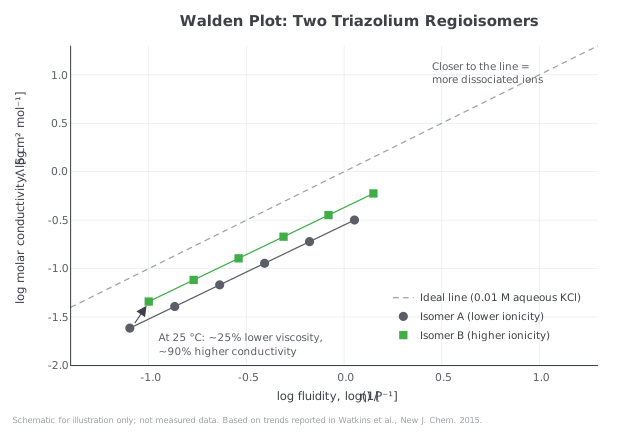
The implication is direct: the next leap in ionic liquid electrolytes is a chemistry problem, not a formulation problem. We return to what that means at the end of this guide.
Electrochemical Stability Window (ESW)
ESW is the voltage range in which the electrolyte neither oxidizes nor reduces. It sets the hard limit on cell voltage and, by extension, energy density.
For most lithium-ion applications, you need an ESW that comfortably exceeds the cathode’s upper cutoff voltage. High-nickel NMC and NCA cathodes push to 4.3–4.5 V vs. Li/Li⁺; lithium-rich layered oxides (LRLO) can reach 4.8 V. Imidazolium-based ionic liquids typically offer ESWs of 4.5–5.0 V, while pyrrolidinium and piperidinium systems routinely exceed 5.5 V, making them the better choice for high-voltage chemistries.
For anodes, cathodic stability matters. Pyrrolidinium cations with bis(fluorosulfonyl)imide (FSI⁻) or bis(trifluoromethanesulfonyl)imide (TFSI⁻) anions are among the most stable at lithium metal potentials, making them leading candidates for lithium-metal and silicon anodes.
When ionic liquids are used as additives at 0.5–10 wt% in a carbonate host, the bulk ESW is still governed by the carbonate solvent. The ionic liquid’s role shifts from providing the electrochemical window to operating within it selectively: it decomposes preferentially at the electrode surface during formation, contributing its decomposition products to the SEI or CEI without needing to survive the full voltage sweep. This means even imidazolium-based ILs, which have narrower ESWs as neat electrolytes, can function effectively as additives in high-voltage cells because they are consumed during interphase formation, not bulk cycling.
Viscosity and Ionic Conductivity
Ionic liquids are denser and more viscous than organic solvents, a consequence of the strong Coulombic interactions between their ions, the same interactions that give them negligible vapor pressure and non-flammability. At room temperature, neat ionic liquid electrolytes typically show conductivities of 0.5–10 mS/cm, compared to 10–15 mS/cm for conventional LP30. That gap narrows at elevated temperatures and can be addressed at the formulation stage.
The most effective levers are:
- Temperature: Conductivity can roughly double for every 20 °C increase, depending on the system. If your application can tolerate 40–60 °C operation, ionic liquids become highly competitive.
- Anion selection: FSI⁻ consistently outperforms TFSI⁻ on conductivity by 30–50% at equivalent conditions, because the smaller anion reduces viscosity.
- Co-solvent blending: Adding a small fraction (10–20 wt%) of a conventional solvent or ionic liquid diluent can raise conductivity significantly while retaining most of the safety benefit.
- Salt concentration: Lithium salt loading (LiTFSI or LiFSI, typically 0.5–1.5 M) affects both conductivity and SEI chemistry; optimization is cell-specific.
- Molecular design for ionicity: Ionicity is independently tunable through cation architecture. As the triazolium example above shows, isomers of identical molecular weight can differ by 90% in conductivity because of how their ions pack and dissociate.
When ionic liquids are used as additives at low loadings, the viscosity penalty largely disappears. The bulk transport properties remain those of the carbonate host, and the ionic liquid’s contribution is chemical rather than transport-mechanical: it modifies the interphase rather than carrying current through the bulk. This is why the additive approach has gained traction rapidly. You do not need to solve the viscosity problem to capture the interfacial benefits.
RoCo routinely formulates blended electrolytes targeting specific conductivity-stability trade-offs. If you’re working on a custom cell, send us your target conductivity, voltage window, and operating temperature. Our R&D team will recommend a starting formulation, often within a single consultation.
Thermal Stability and Safety Profile
One of the strongest arguments for ionic liquid electrolytes is the safety case. Thermal runaway in Li-ion batteries is almost always initiated by electrolyte decomposition and gas generation; removing the flammable solvent fundamentally changes the failure mode.
Key metrics to specify:
- Decomposition onset temperature (TGA): Most pyrrolidinium/TFSI or FSI systems exceed 300 °C onset. Imidazolium systems vary more widely.
- Flash point: Ionic liquids have no measurable flash point, a significant advantage for automotive and aerospace certifications.
- Vapor pressure: Effectively zero, which eliminates evaporative loss and simplifies cell sealing requirements.
For applications in solid-state batteries, where the electrolyte is in direct contact with a lithium metal anode at elevated temperatures, thermal stability is not a nice-to-have. It is a qualification gate. Pyrrolidinium-FSI and piperidinium-TFSI systems are among the most tested in this regime.
Even at additive loadings of 5–10 wt%, ionic liquids provide a measurable safety benefit. They reduce the overall flammability of the electrolyte blend, lower peak heat release rate in accelerating rate calorimetry (ARC), and can suppress gas generation during abuse.
The mechanism is twofold: the IL displaces a fraction of the flammable solvent by volume, and the fluorine-rich SEI it forms acts as a more thermally stable barrier layer on the anode, delaying the onset of exothermic reactions. It is not a substitute for a fully non-flammable system, but it shifts the abuse tolerance window meaningfully.
Electrode Compatibility and SEI Chemistry
Selecting an ionic liquid that is electrochemically stable is necessary but not sufficient. The electrolyte must also form a stable solid-electrolyte interphase (SEI) on the anode and a stable cathode-electrolyte interphase (CEI) on the cathode, ideally in the first few formation cycles.
FSI⁻-based ionic liquids have become the preferred choice for graphite and silicon anodes because FSI⁻ decomposition products form a thin, ionically conductive SEI that supports good cycle life. TFSI⁻ tends to form thicker, higher-impedance SEI layers, which can be problematic for fast charging or low-temperature operation but are acceptable in applications where safety margin outweighs rate capability.
Additive chemistry plays a significant role here. Small quantities of fluoroethylene carbonate (FEC), vinylene carbonate (VC), or purpose-built ionic liquid additives can substantially improve SEI stability, particularly on silicon-dominant anodes, which expand and contract significantly during cycling.
The additive use case is where ionic liquids arguably deliver their highest value-to-loading ratio. Because the IL anion’s reduction potential sits above that of the carbonate solvent, it gets first access to the anode surface during formation and templates the inner SEI layer.
A thin, LiF-rich, ionically conductive inner layer, formed mainly from FSI⁻ decomposition, protects the anode from continued solvent decomposition, reducing irreversible capacity loss and impedance growth. On silicon anodes, where the SEI must survive repeated 300%+ volume expansion, this templating effect is particularly valuable: the IL-derived inner layer is mechanically more robust than a purely carbonate-derived SEI.
Quick-Reference: Matching IL Families to Battery Chemistries
| Battery Chemistry | Recommended IL Cation | Recommended Anion | Key Reason |
|
Standard Li-ion (NMC/LFP)
|
Pyrrolidinium (Pyr₁₄) | FSI⁻ |
Balanced conductivity + SEI |
|
High-voltage Li-ion (>4.5 V) |
Piperidinium or Pyr₁₄ | TFSI⁻ | Wide ESW, oxidative stability |
|
Lithium metal / solid-state |
Pyrrolidinium | FSI⁻ or FSI⁻/TFSI⁻ blend | Stable Li⁰ interphase |
| Sodium-ion | Pyrrolidinium or Piperidinium | FSI⁻ | Na⁺ solvation, low viscosity |
|
Lithium-sulfur |
Imidazolium or Pyr₁₄ |
TFSI⁻ | Polysulfide shuttle suppression |
| IL additive in carbonate | Imidazolium or Pyrrolidinium | FSI⁻ | Preferential SEI templating |
The Future: Designed Ionic Liquid Electrolytes
Ionic liquid additives in carbonate electrolytes are delivering real, near-term value. They improve interphase chemistry, extend cycle life, and widen the abuse tolerance window without requiring manufacturers to overhaul their processes. That work matters, and it will continue to grow.
But the additive approach is a bridge, not a destination.
The fundamental limitations of carbonate electrolytes (flammability, gas generation, and decomposition above 4.5 V) are properties of the solvent itself. Additives can delay and mitigate these failure modes. They cannot eliminate them. The only way to fully remove flammability from a liquid electrolyte is to remove the flammable component, and that means a neat or near-neat ionic liquid system.
The historical barrier to that transition has been conductivity. But the framing of “ionic liquids are too viscous” is increasingly outdated. What limited early IL electrolytes was not ionic liquids as a class; it was the specific ions that happened to be commercially available. The conductivity problem is a molecular design problem, and it is solvable.
The evidence is already in the literature, including the triazolium study described above: conductivity can be tuned independently of viscosity by engineering ionicity. The design variables are specific and accessible: charge distribution on the cation, steric environment around the charged centers, and the geometry of ion packing in the liquid state. These are not abstract parameters. They respond to synthetic choices: a methyl versus an ethyl, a substitution at nitrogen versus carbon, a symmetric versus asymmetric cation.
The next generation of ionic liquid electrolytes will not come from screening catalogs of existing salts. It will come from purpose-built cation architectures where ionicity is a design target alongside thermal and electrochemical stability. Platforms like the 1,2,3-triazolium system, which offer synthetic modularity and systematic tunability, are precisely the kind of scaffold that enables this approach.
This is where RoCo operates. Our research program spans the full arc from molecular design through physical property characterization to electrolyte formulation. Whether the starting point is an additive package for an existing carbonate cell or a custom ionic liquid for a next-generation solid-state system, the underlying capability is the same: understanding how ion structure governs transport, and using that understanding to build electrolytes that perform. We partner with battery developers at every stage, from early material screening to scale-up. If you’re ready to see what a designed ionic liquid could do for your cell, let’s talk.
Working with RoCo on Custom Formulations
Off-the-shelf ionic liquids cover a large part of the design space, but high-performance battery electrolytes often require custom salt concentrations, additive packages, or blended co-solvent systems that aren’t available from a catalog.
RoCo’s contract R&D team has developed electrolyte formulations for university battery groups, national laboratory programs, and SBIR-funded startup programs. Engagements typically begin with a 15-minute no-cost consultation to scope the project, followed by a formal statement of work if custom synthesis or optimization is needed.
If you’re at the material selection stage and want to discuss which ionic liquid family fits your cell chemistry, book a consultation with our R&D team: visit our contact page. It’s a fast way to avoid the most common selection mistakes before committing to a full cell build.
References
Watkins, J. D.; Roth, E. A.; Lartey, M.; Albenze, E.; Zhong, M.; Luebke, D. R.; Nulwala, H. B. New J. Chem. 2015, 39, 1563–1566. [DOI link]
Frequently Asked Questions
What is the best ionic liquid for a lithium-ion battery electrolyte?
There is no single best ionic liquid for all lithium-ion applications, but N-methyl-N-propylpyrrolidinium bis(fluorosulfonyl)imide (Pyr₁₃FSI) and its butyl analog (Pyr₁₄FSI) are the most widely studied and consistently high-performing choices for standard graphite-anode Li-ion cells. They offer a good electrochemical stability window, competitive ionic conductivity relative to other ionic liquids, and a well-characterized SEI on graphite. High-voltage cathodes or lithium-metal anodes may require a different cation or anion.
Can ionic liquids be used as additives in conventional battery electrolytes?
Yes, and this is one of the fastest-growing areas of ionic liquid application in batteries. At 0.5–10 wt% in standard carbonate electrolytes, ionic liquids act as SEI-forming additives. The IL anion (particularly FSI⁻) decomposes preferentially during formation cycling, templating a thinner, more ionically conductive, and more mechanically stable interphase on the anode. This approach delivers interphase benefits without the viscosity penalty of a full ionic liquid electrolyte and requires minimal changes to existing manufacturing processes.
Are ionic liquid electrolytes compatible with standard lithium-ion battery manufacturing?
Generally yes, with some adjustments. Ionic liquids are compatible with most current-collector materials (aluminum, copper) and common cathode active materials. The main manufacturing adaptation is that higher-viscosity ionic liquids require modified filling and soak processes. Elevated temperature or blending with a diluent typically resolves this. Electrode wetting can also take longer, so formation protocols may need adjustment.
How does ionic liquid electrolyte performance compare to conventional electrolytes at low temperatures?
This is a genuine limitation. Ionic liquid viscosity increases sharply below 0 °C, which reduces ionic conductivity and rate capability at sub-ambient temperatures. For applications in cold climates or cold storage, blended ionic liquid / co-solvent systems or ionic liquids with lower melting points (e.g., certain phosphonium or asymmetric pyrrolidinium systems) can extend the usable temperature range. This is an active area of formulation research.
Can ionic liquid electrolytes be used in solid-state batteries?
Yes, and this is one of the most promising near-term applications. Ionic liquids can be incorporated into solid or quasi-solid electrolyte matrices (polymer, ceramic, or composite) to improve ionic conductivity and interfacial contact. Pyrrolidinium-FSI systems have been demonstrated with both LLZO and sulfide-based ceramic electrolytes, improving room-temperature performance without compromising thermal stability.
What purity level do I need for battery-grade ionic liquid electrolytes?
Battery applications require high-purity ionic liquids, typically ≥99% (often ≥99.5%), with tightly controlled water content (typically below 20 ppm, with 50 ppm as an upper limit) and halide levels. Trace halides and water are the most common sources of capacity fade and cell impedance growth in ionic liquid electrolyte systems. RoCo supplies battery-grade ionic liquids with full CoA documentation and can provide materials at custom purity specifications for demanding applications.
Why are some ionic liquids more conductive than others with similar viscosity?
Conductivity in ionic liquids depends not only on viscosity but on ionicity: the fraction of ions moving as independent charge carriers rather than as correlated pairs. Molecular structure, specifically the charge distribution on the cation, steric access around charged centers, and ion packing geometry, determines how readily ions dissociate. In our triazolium regioisomer study, two ionic liquids with identical molecular weight differed by only 25% in viscosity but by 90% in conductivity, simply because of where the alkyl chain sat on the cation ring. That is why ionicity, not just viscosity, is now a primary design target.