
Ask a chemist selecting an ionic liquid how they chose the alkyl chain length on their cation, and the honest answer is usually: they didn’t. They picked 1-ethyl-3-methylimidazolium or 1-butyl-3-methylimidazolium because that’s what the literature used, and the chain length came along for the ride. This is understandable. The cation family and anion combination tend to dominate the discussion. Nevertheless, it’s also a missed opportunity, because the alkyl chain is not an inert appendage. It controls the internal architecture of the liquid at the nanoscale, and that architecture determines whether your ionic liquid performs brilliantly or fails quietly in your application.
Ionic Liquids Are Not Homogeneous Solvents
For the first decade of modern ionic liquid research, these materials were treated as homogeneous “liquid salts” — structurally uniform at the molecular level, with properties that could be predicted from simple ion-pair considerations. Early influential reviews described their structure as unlikely to differ greatly from molten salts. That picture changed decisively in the mid-2000s.
In 2006, Canongia Lopes and Pádua published molecular dynamics simulations showing that ionic liquids with sufficiently long alkyl chains spontaneously segregate into polar and nonpolar nanodomains (J. Phys. Chem. B 2006, 110, 3330). Specifically, the polar regions consist of cation head groups and anions, held together by Coulombic interactions. The nonpolar regions consist of aggregated alkyl chains, interacting through weaker van der Waals forces. A year later, Triolo, Russina, Bleif, and Di Cola provided the first experimental X-ray diffraction evidence confirming these predictions in neat room-temperature ionic liquids (J. Phys. Chem. B 2007, 111, 4641).
Key Experimental Evidence
The critical finding from Triolo’s work: domain size scales linearly with alkyl chain length, increasing by 2.1 Å per CH2 unit. At C3 (propyl), no diffraction peak is observed — the liquid looks structurally homogeneous. By C4 (butyl), a broad hump appears. At C6, C8, and C10, the peak becomes progressively sharper and more intense, indicating increasingly well-defined nanoscale organization. Domain spacings range from roughly 15 Å at C4 to 27 Å at C10.
Importantly, subsequent work confirmed that this nanostructuring is largely independent of the anion. Triolo’s group showed that chloride, tetrafluoroborate, and hexafluorophosphate salts all produce nearly identical domain spacings for the same cation chain length. The anion occupies space in the polar domain and influences local packing, but the nanoscale segregation itself is driven almost entirely by alkyl chain aggregation. As a result, Hayes, Warr, and Atkin compiled these findings across the entire field in their comprehensive 2015 review (Chem. Rev. 2015, 115, 6357), establishing nanostructuring as one of the defining features of ionic liquid behavior.
From Globular Islands to a Bicontinuous Sponge
The nanostructure is not the same at every chain length — it undergoes a qualitative morphological transition as the alkyl chain grows. Understanding this transition is essential for predicting how a given ionic liquid will behave.
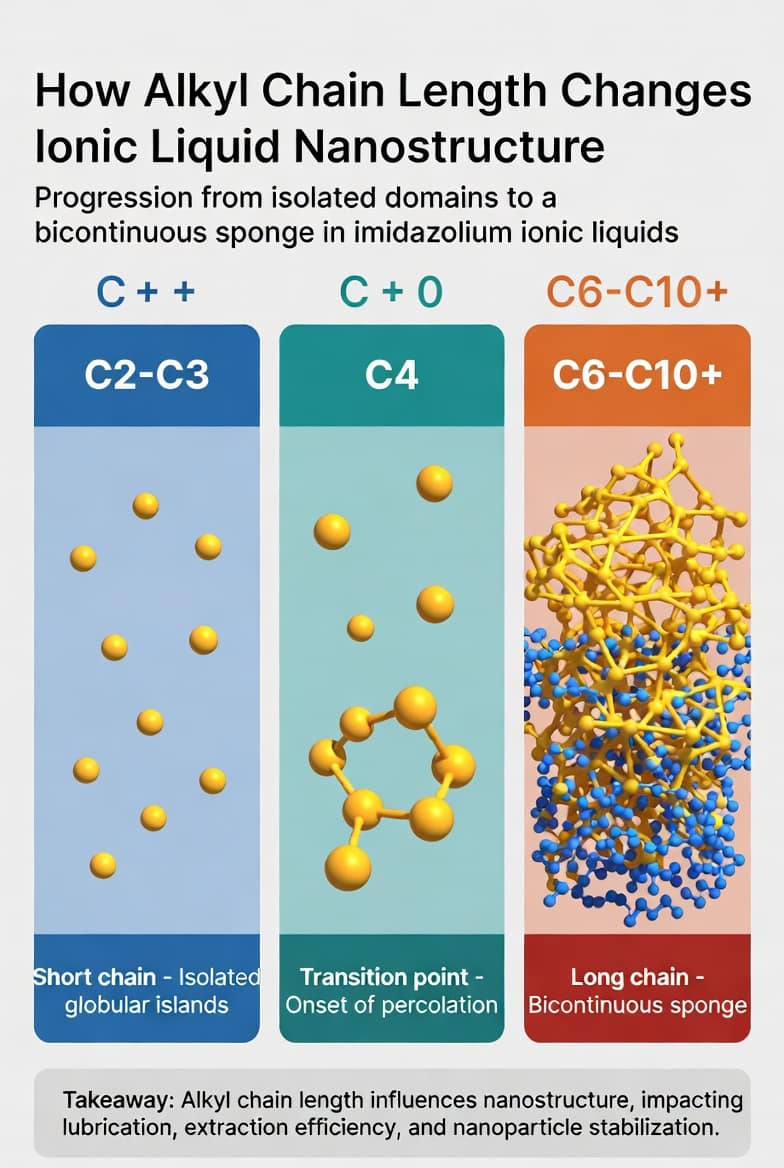
At short chain lengths (C2), the nonpolar domains are small, disconnected globular “islands” of hydrocarbon embedded in a continuous ionic matrix. Consequently, the charged network dominates. As a result, these liquids behave approximately as the homogeneous solvents they were once assumed to be.
The Three Structural Regimes
At C4 (butyl), the system reaches a structural crossover. The alkyl domains begin to connect, forming the onset of a percolated network. This is the chain length at which a low-Q diffraction peak first becomes experimentally detectable — marking the transition from a liquid with local heterogeneities to one with genuine mesoscale order.
At C6 and beyond, the nonpolar domains interconnect fully into a bicontinuous, sponge-like nanostructure. The liquid now consists of two interwoven, continuous subvolumes — one polar, one nonpolar — resembling the L3 sponge phase familiar from surfactant science. The area ratio of polar to nonpolar interfaces (aalkyl/apolar) approaches unity, which is the hallmark of a locally planar, bicontinuous architecture. This is not a micelle-like structure with discrete aggregates — it is a connected, interpenetrating network.
Ultimately, this morphological progression — globular to percolated to bicontinuous — matters because it changes what the liquid can do. For example, a C2 ionic liquid with isolated nonpolar pockets has fundamentally different solvation, transport, and interfacial behavior than a C8 ionic liquid with a fully connected sponge-like architecture.
When Nano-structuring Works for You
The presence of organized nonpolar nanodomains creates capabilities that a homogeneous ionic solvent cannot provide. Moreover, the bicontinuous architecture is particularly powerful because both polar and nonpolar domains are continuous and accessible throughout the liquid. Three application areas illustrate this.
Lubrication and Surface Protection
At a metal surface, ionic liquids with longer alkyl chains form layered adsorbed films: the charged head groups orient toward the surface, while the alkyl tails extend outward, creating an ordered molecular brush. This interfacial layering is a direct extension of the bulk nanostructure — the sponge-like morphology in the bulk becomes lamellar-like near the solid interface, as the surface aligns and flattens the pre-existing polar/nonpolar domains. Longer chains produce thicker, more robust films that resist being squeezed out under compression. Huang et al. (ACS Omega 2024, 9, 3184) showed that both friction reduction and wear protection correlate positively with cation chain length, with the mechanism being twofold: more stable adsorbed layers and milder tribochemical reactions at the surface.
For lubrication work, RoCo® recommends starting with HMIm-TFSI (C6, IL-0098) or OMIm-TFSI (C8, IL-0099) — both fall squarely in the bicontinuous sponge regime.
Selective Solvation and Extraction
The coexistence of polar and nonpolar domains within a single liquid phase means an ionic liquid can simultaneously accommodate solutes of very different polarity. Polar species dissolve into the ionic regions; nonpolar species partition into the hydrocarbon-like nanodomains. Rather, this is not merely a polarity effect — it is a consequence of the liquid having two distinct, structured microenvironments. A C2 ionic liquid offers limited partitioning capability because its nonpolar domains are small, disconnected pockets. A C8 ionic liquid provides substantial, interconnected nonpolar volume that can accommodate hydrophobic solutes, catalytic intermediates, or extraction targets.
For extraction and selective solvation, OMIm-TFSI (C8, IL-0099) and DMIm-TFSI (C10, IL-0100) are our most-specified grades.
Nanoparticle Stabilization
When a nanoparticle is dispersed in a nanostructured ionic liquid, the alternating polar/nonpolar layers wrap around it like concentric shells, creating oscillatory solvation forces — energy barriers that resist aggregation. As a result is kinetic stabilization without added surfactants. Longer alkyl chains produce more pronounced layering and stronger barriers. The C8 system shows significant domain segregation and effective stabilization; the C4 system does not. This is why the size distribution of metal nanoparticles synthesized in ionic liquids is related to the degree of internal nanostructure — nucleation and growth appear to be localized within the nonpolar domains.
For nanoparticle synthesis and stabilization, OMIm-TFSI (C8, IL-0099) is the standard starting point; DDMIm-TFSI (C12, IL-0101) may offer extra benefits in stabilization of nano particles.
When Nanostructuring Works Against You
The same structural features that make nanostructured ionic liquids excellent lubricants and selective solvents make them poor electrolytes. Understanding why requires looking at what the bicontinuous sponge does to ion transport.
Ion Transport and Conductivity
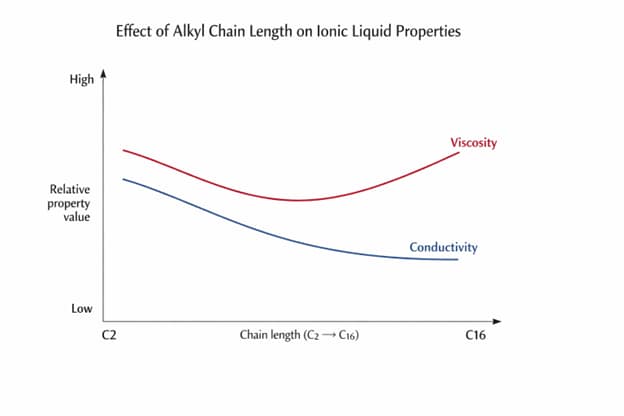
In an electrolyte, what matters is how efficiently ions move from one electrode to the other. Nonpolar nanodomains are, by definition, regions that do not conduct ionic charge. As the alkyl chain lengthens and these domains grow from disconnected pockets into a connected sponge, they become an increasingly effective barrier — dead zones that ions must navigate around. Consequently, ionic conductivity decreases systematically with increasing chain length: within the imidazolium TFSI series, moving from C2 to C8 can reduce conductivity by roughly half.
The Walden plot makes this particularly visible. As chain length increases, ionic liquids deviate further below the ideal Walden line, indicating that a growing fraction of ions are moving as correlated pairs or clusters rather than as free charge carriers. The nanostructure is not just slowing transport — it is reducing the effective number of independent charge carriers.
Viscosity
Viscosity rises steeply with chain length. The dominant contribution comes from van der Waals interactions between alkyl chains within the nonpolar domains — chains entangle, interdigitate, and resist flow. For the imidazolium TFSI series, viscosity can increase by an order of magnitude between C2 and C10. The practical consequence is slower mass transport, slower electrode kinetics, and more difficult processing.
Mesophase Formation at Long Chain Lengths
Beyond approximately C12, many ionic liquids cross a structural threshold. The alkyl chains become long enough to pack into ordered lamellar, columnar, or smectic phases that resemble liquid crystals more than free-flowing liquids. Melting points, which initially decrease with chain length (disrupting crystal packing symmetry), begin to rise again past C10 as cohesive van der Waals interactions dominate. If what you need is a mobile, isotropic solvent, a C14 or C16 ionic liquid may not cooperate.
Why This Matters: ILs Are Structurally Unique Among Solvents
It is worth pausing to appreciate how unusual this nanostructuring is. Virtually every other class of liquid solvent — atomic, diatomic, molecular, even molten salts — lacks structure beyond a preferred separation between adjacent molecules. Water has its tetrahedral hydrogen bond network; alcohols form chain-like aggregates; molten NaCl shows charge ordering over a few coordination shells. But none of these possess a repeat correlation length between organized domains. Ionic liquids do. They have a preferred separation, a preferred orientation, and a periodic nanoscale architecture. This makes them more structurally analogous to microemulsions or liquid crystals than to conventional solvents — except that the nanostructure forms spontaneously in the pure liquid, without requiring a second component or surfactant.
Indeed, this structural uniqueness is not academic. It is why ionic liquids can simultaneously dissolve polar and nonpolar solutes, why they form robust interfacial films, why they stabilize nanoparticles, and why they penalize ion transport at longer chain lengths. In short, the nanostructure is the mechanism behind all of these behaviors.
Chain Length as a Nanostructure Design Parameter
Taken together, the picture that emerges is consequential: the alkyl chain length does not simply adjust viscosity or conductivity on a sliding scale. Instead, it controls whether and to what extent an ionic liquid develops internal nanostructure — and through what morphology — and that nanostructure determines performance in fundamentally different ways depending on the application.
For instance, for an electrolyte, the optimal chain length is short — C2 or C3 — because the priority is fast ion transport, high conductivity, and minimal ion correlation. You want the globular regime, where the nonpolar domains are too small to impede transport.
Similary, for a lubricant additive, the optimal chain length is longer — C6 to C8 or beyond — because the priority is a thick, ordered adsorbed film at the surface. You want the bicontinuous sponge regime, where the nanostructure is the mechanism of action.
For extraction or catalysis involving hydrophobic substrates, the chain length determines how much nonpolar solvent capacity exists within the ionic matrix. Too short and the ionic liquid cannot accommodate the substrate; too long and the liquid becomes impractically viscous.
Matching Chain Length to Your Application
There is no universally “best” chain length. There is only the chain length that matches the nanostructural requirements of your application.
At RoCo®, we maintain the full 1-alkyl-3-methylimidazolium TFSI series from C2 through C16 precisely because this range spans the full spectrum of nanostructural behavior: from minimal domain segregation at C2 to pronounced bicontinuous sponge-like nanostructuring at C8, to mesophase-forming compositions at C14 and C16. The same depth exists across our pyrrolidinium, piperidinium, and phosphonium product lines. We stock this breadth because years of working with these materials have taught us that chain length is a design decision, not an afterthought.
Selecting the Right Chain Length for Your Application
If you’re developing an application where ionic liquid selection matters — whether in energy storage, lubrication, separations, or advanced materials — the alkyl chain length is one of the most consequential decisions you’ll make. RoCo®‘s technical team brings deep structure-property expertise to that decision, and as a North American distributor of IoLiTec, we deliver one of the world’s largest ionic liquid catalogs with U.S.-based logistics.
Two ways to move forward:
- Contact us to reach out technical team
- Browse the catalog — explore our full ionic liquid catalog to see the range of chain lengths available across cation families.
References
Triolo, A.; Russina, O.; Bleif, H.-J.; Di Cola, E. “Nanoscale Segregation in Room Temperature Ionic Liquids.” J. Phys. Chem. B 2007, 111, 4641–4644.
Canongia Lopes, J. N.; Pádua, A. A. H. “Nanostructural Organization in Ionic Liquids.” J. Phys. Chem. B 2006, 110, 3330–3335.
Hayes, R.; Warr, G. G.; Atkin, R. “Structure and Nanostructure in Ionic Liquids.” Chem. Rev. 2015, 115, 6357–6426.
Huang, G.; Sun, L.; Li, L.; et al. “Exploring the Effect Mechanism of Alkyl Chain Lengths on the Tribological Performance of Ionic Liquids.” ACS Omega 2024, 9, 3184–3192.
Wang, Y.; Voth, G. A. “Molecular Dynamics Simulations of the Structural Organization in RTILs.” J. Am. Chem. Soc. 2005, 127, 12192.
Russina, O.; Triolo, A. “Faraday Discussions on the Mesoscopic Model.” Faraday Discuss. 2012, 154, 97–109.
Tokuda, H.; Hayamizu, K.; Ishii, K.; Susan, M. A. B. H.; Watanabe, M. “Physicochemical Properties and Structures of RTILs.” J. Phys. Chem. B 2005, 109, 6103–6110.
Cai, M.; Yu, Q.; Liu, W. “Ionic Liquid Lubricants: When Chemistry Meets Tribology.” Chem. Soc. Rev. 2020, 49, 7753–7818.
Pensado, A. S.; Pádua, A. A. H. “Solvation and Stabilization of Metal Nanoparticles in Ionic Liquids.” Angew. Chem. Int. Ed. 2011, 50, 8683–8687.
Table 1: RoCo®‘s CnMIM-TFSI Series: Full Chain Length Range
| Chain | Common Name | SKU | CAS | Viscosity (cP) (RT) | ECW (V) (RT) | Nanostructure Regime | Primary Use |
| C2 (ethyl) | EMIm-TFSI | IL-0023-UP/ IL-0023-OP | 174899-82-2 | ~39 | ~4.7 | Homogeneous – no domains | Electrolytes, high-conductivity applications |
| C3 (propyl) | PMIm-TFSI | IL-0024-HP/ | 216299-72-8 | 56 (19°C) | ~4.9 | Pre-threshold – onset | Electrolytes, transitional, solvents |
| C4 (butyl) | BMIm-TFSI | IL-0029-UP/IL-0029-OP | 174899-83-3 | 48.8 | 4.62 | Percolation threshold – domains emerge | Electrolytes, solvent, solar cells |
| C5 (pentyl) | C5MIm-TFSI | IL-0300-HP | 280779-53-5 | 59.3 | Early bicontinuous | Research | |
| C6 (hexyl) | HMIm-TFSI | IL-0098-HP/IL-0098-UP | 382150-50-7 | ~63 | 5.3 | Bicontinuous sponge | Lubrication, extraction |
| C7 (heptyl) | C7MIm-TFSI | IL-0301-HP | 425382-14-5 | — | — | Bicontinuous sponge | Research, extraction |
| C8 (octyl) | OMIm-TFSI | IL-0099-HP | 178631-04-4 | 106 | — | Full bicontinuous | Lubrication, hydrophobic extraction |
| C9 (nonyl) | NonMIm-TFSI | IL-0302-HP | 433337-21-4 | — | Transitional bicontinuous | Catalysis, Supported ionic liquid phase, lubricants | |
| C10 (decyl) | DMIm-TFSI | IL-0100-HP | 433337-23-6 | 113 | 4.6 | Mature bicontinuous | Extraction, advanced lubrication, catalysis |
| C12 (dodecyl) | DDMIm-TFSI | IL-0101-HP | 404001-48-5 | 213.7 (18°C) | — | Approaching mesophase | Specialized surface applications, Research, catalysis, lubrication |
| C14(tetradecyl) | TETRADECMIm -TFSI | IL-0102-HP | 404001-49-6 | — | — | Mesophase / liquid crystal-like | Coatings, Extraction, oil and gas, supported ionic liquid phase, lubricants |
| C16 (hexadecyl) | HDMIm-TFSI | IL-0103-HP | 404001-50-9 | — | — | Mesophase / liquid crystal-like | Surface coatings, surfactant, nano material synthesis |
| C18
(octadecyl) |
OctadecMIM-TFSI | IL-0200-HP | 404001-51-0 | — | — | Liquid crystal like | Coatings, extraction |
Frequently Asked Questions
What alkyl chain length is best for ionic liquid electrolytes?
Short chains – C2 (ethyl) or C3 (propyl) – are optimal for electrolyte applications. At these lengths, nonpolar nanodomains remain small and disconnected, preserving fast ion transport and high ionic conductivity. Moving from C2 to C8 within the imidazolium TFSI series can reduce conductivity by roughly half.
What purity grades does RoCo® offer for imidazolium-TFSI ionic liquids?
Most CnMIM-TFSI products are available in three grades: HP (>99%, suitable for most synthesis and screening work), UP (>99.5%, for electrochemistry and analytical applications where trace halides matter), and OP (>99.9%, for battery electrolytes and high-end research). Grade selection depends on whether residual chloride or water will affect your results — the applications team can advise.
What are typical lead times for ionic liquid orders?
In-stock SKUs from the RoCo® catalog typically ship within 3-5 business days from U.S. inventory. Custom synthesis and bulk quantities are quoted on request; as a North American distributor of IoLiTec, RoCo® can also source the broader IoLiTec catalog with reduced transit time compared to direct European import.
Can I order imidazolium-TFSI ionic liquids in kilogram quantities?
Yes. Most catalog SKUs are listed in gram quantities online, but kilogram and multi-kilogram orders are available on request for scale-up and pilot work. Contact the applications team for pricing and lead time on quantities above the listed catalog sizes.
At what chain length does nanostructuring appear in imidazolium ionic liquids?
Nanostructuring becomes experimentally detectable by small-angle X-ray scattering at C4 (butyl). Below C4, the liquid appears structurally homogeneous. At C4, a broad diffraction peak emerges, and by C6 through C10 the peak sharpens progressively, indicating well-defined polar and nonpolar nanodomains.
Why do longer alkyl chain ionic liquids have higher viscosity?
Van der Waals interactions between alkyl chains within the nonpolar nanodomains are the primary driver. As chains lengthen, they entangle and interdigitate within these domains, resisting flow. Viscosity in the imidazolium TFSI series can increase by an order of magnitude between C2 and C10.
Which ionic liquid chain length is best for lubrication?
C6 to C8 is the practical optimum for most lubrication applications. At these lengths, the bicontinuous sponge-like nanostructure is fully developed, enabling thick, ordered adsorbed films at metal surfaces. Longer chains produce more robust films but at the cost of higher viscosity and more difficult handling.
Does the anion affect ionic liquid nanostructure?
The anion has minimal effect on nanoscale domain spacing. Triolo et al. showed that chloride, tetrafluoroborate, and hexafluorophosphate salts produce nearly identical domain spacings for the same cation chain length. The anion occupies the polar domain and influences local packing but does not drive the nanoscale segregation, which is controlled by alkyl chain aggregation.
What happens to ionic liquid structure above C12?
Beyond approximately C12, many ionic liquids begin forming ordered lamellar or smectic phases resembling liquid crystals. Melting points, which initially decrease with chain length, begin rising again past C10 as van der Waals cohesion between chains dominates. These materials may no longer behave as free-flowing isotropic liquids at room temperature.