
Corrosion is a multi-trillion-dollar problem:
According to the National Association of Corrosion Engineers, the global cost of corrosion is estimated to be 3.4% (or $2.5 trillion) of global GDP. These costs typically exclude aspects such as individual safety or environmental consequences. Typical corrosion protection coatings are sacrificial (coating with a second metal, e.g., zinc) or barrier polymer coating, ceramic coatings, or protection oils based on paraffinic or naphthenic mineral oils.
Polyoxometalates:
Polyoxometalates (POMs) are a large group of anionic polynuclear metal–oxo clusters with discrete and chemically modifiable structures. POM can exist in electron-rich reduced forms of different archetypes, structural flexibilities, and functionalities. POM materials have unique and potentially valuable catalytic, electronic, and magnetic material applications.
POM-IL as corrosion protection:
Streb and coworkers developed POM-based ionic liquids (POM-ILs), showing noticeable corrosion protection with self-healing properties. These POM-ILs are constituted by ammonium ions of the type (CnH2n+1)4N+ with n = 7-8 and transition metal (TM) functionalized Keggin anions of the type [SiW11O39TM(H2O)]n- with TM = Cu(II) or Fe(III) (Figure 1). Corrosion protection experiments were carried out on a copper disk drop-coated with the novel POM-ILs. The results were superior to coating with a solid POM salt and the commercially available IL 1-hexyl-3-methylimidazolium bromide (HMIM Br) (IL-0069-HP) as the reference.
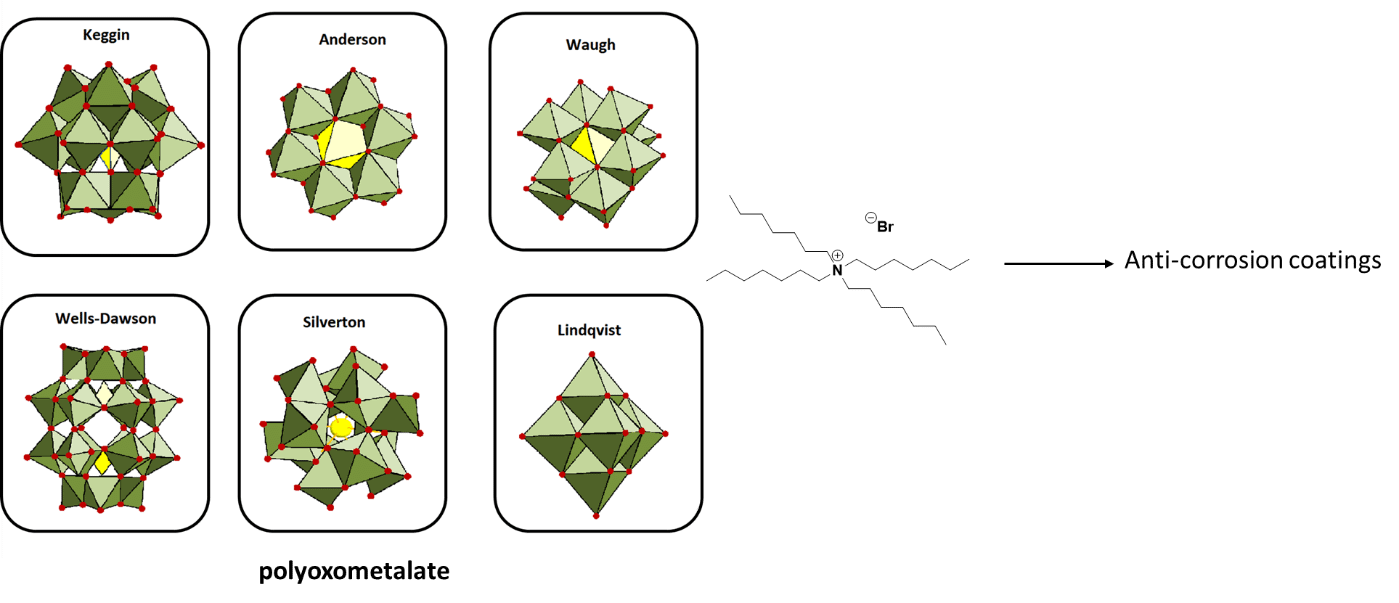
Figure 1: POM-IL resulting in anti-corrosion self-healing coating. The figure above showing mixtures of POM with ammonium-based ionic liquids.
Protection against Biodeterioration and weathering:
Another type of corrosion is the corrosion of building materials (Stones, cement, and Concrete). It is a major global issue. POM-IL coatings also show significant corrosion protection on stones and building materials as well. A 2018 study shows that the use of POM-IL thin layers can protect concrete and stone from acid corrosion (“weathering”) and biofilm formation (“biodeterioration”) (Figure 2). Stone samples are coated with hydrophobic, acid-resistant POM-ILs featuring biocidal properties that resulted in better performance.
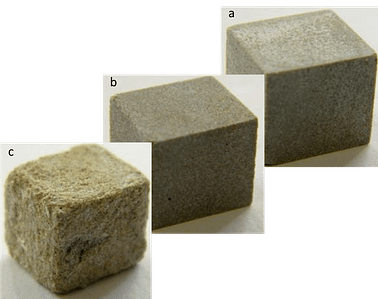
Figure 2: Images adapted from work performed by Streb 2018. The Rosemary stone was tested for acid vapor corrosion by exposing the samples to acetic acid vapor for 72 h. Sample a and b are treated with thin layer POM-ILs showing little or no acid corrosion where is C is untreated.
Our partner, IoLiTec GmBH, has tested several ionic liquids (ILs) as promising corrosion inhibitors. In this work, IoLiTec obtained optimal results with several acetate-based ILs. In addition, 1-butyl-1-methylpyrrolidinium acetate and 1- ethyl-3-methylimidazolium acetate has good corrosion protection properties. The former can be custom ordered at info@roco.global. You can purchase 1-ethyl-3-methylimidazolium acetate (IL- 0189) on our website.
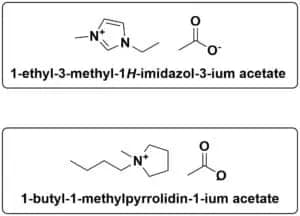 Figure 3: Chemical structure of the 1-butyl-1-methylpyrrolidinium acetate and 1- ethyl-3-methylimidazolium acetate also has good corrosion properties with POM.
Besides POM-based ILs, significant anti-corrosion effects can also be obtained by subtle tuning of the IL structure. For instance, applying stable bis(trifluoromethylsulfonyl)imide (BTA) anions instead of metal invasive halides can drastically improve the anti-corrosion properties and change the cation structure. RoCo can design and synthesize novel ILs to give you an innovative edge.
Contact RoCo today to learn more about our Research & Development Services and how we can help you exceed your goals.
Frequently Asked Questions
What is corrosion protection?
Corrosion protection includes methods used to prevent or slow the degradation of metals caused by chemical or electrochemical reactions with the surrounding environment.
How do ionic liquids prevent corrosion?
Ionic liquids adsorb onto metal surfaces and form a protective barrier that limits interaction with corrosive species, reducing corrosion reactions and material degradation.
What industries use ionic liquids for corrosion protection?
Industries such as oil & gas, chemical manufacturing, metal processing, and energy systems use ionic liquids to improve durability and reduce maintenance.
Are ionic liquids effective corrosion inhibitors?
Yes, ionic liquids are highly effective corrosion inhibitors. They form stable, protective films on metal surfaces and can significantly reduce corrosion rates in aggressive environments.