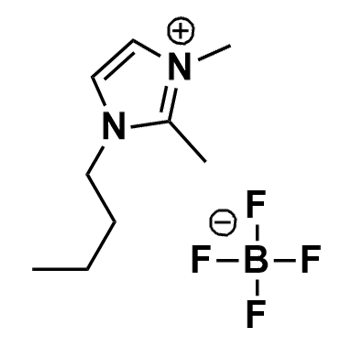
1-Butyl-2,3-dimethylimidazolium tetrafluoroborate, >99%
Price range: $148.58 through $9,179.29
Product Code: IL-0058-HPCAS NO: 402846-78-0
- Chemical Formula: C9H17BF4N2
- Synonyms: BDiMIM BF4, Im114 BF4
- Anion decomposes slowly in the presence of water
- Aromatic
Conductivity: 2.16 mS/cm (45 °C)
SUM Formula: C9H17BF4N2
Molecular Weight: 240.05
Melting Point: 36 °C
Density: 1.239 g/cm³
Purity: >99%
Viscosity: 172 cP (45 °C)
- SUM Formula: C9H17BF4N2
- Molecular Weight: 240.05
- Melting Point: 36 °C
- Density: 1.239 g/cm³
- Viscosity: 172 cP (45 °C)
1-Butyl-2,3-dimethylimidazolium tetrafluoroborate, CAS: 402846-78-0
Key Applications:
Electrochemical Systems
- Serves as a stable, low‑volatility ionic medium for electrochemical studies requiring wide electrochemical windows.
- Supports high ionic conductivity in prototype electrolytes for capacitors, redox systems, and electrodeposition research.
- Useful in evaluating ion‑transport behavior in mixed‑solvent or solvent‑free electrolyte formulations.
Catalysis and Synthesis
- Functions as a non‑volatile reaction medium for acid‑sensitive or moisture‑sensitive transformations where BF₄⁻ stability is advantageous.
- Enables selective catalytic processes involving transition‑metal complexes, particularly where imidazolium cations enhance solubility or ligand behavior.
- Applied in biphasic and recyclable catalytic systems due to its thermal stability and low vapor pressure.
Separation Science
- Employed as a tunable solvent for liquid–liquid extraction of metal ions, organic compounds, and hydrophobic analytes.
- Supports chromatographic method development as an additive or stationary‑phase modifier to adjust polarity and retention behavior.
Materials and Polymer Science
- Acts as a structuring agent or ionic plasticizer in polymer matrices, improving conductivity and mechanical flexibility.
- Used in preparing ionogels and hybrid materials where BF₄⁻ contributes to stable, low‑moisture ionic environments.
- Facilitates dispersion and stabilization of nanoparticles in ionic‑liquid‑based media.
Thermal and Solvation Applications
- Suitable for high‑temperature reaction environments due to its thermal robustness and low flammability.
- Provides a controlled solvation environment for studying solute–ion interactions, viscosity effects, and ionic‑liquid microstructures.
Analytical and Spectroscopic Use
- Serves as a reference ionic medium for NMR, IR, and Raman studies examining cation–anion interactions and solvation dynamics.
- Useful in calibrating or benchmarking physicochemical property measurements such as conductivity, density, and viscosity.
Please contact us if you want to learn more or need assistance with your order.
Related products
-

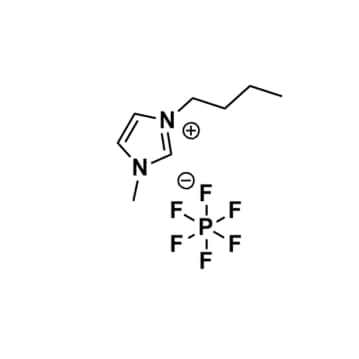
1-Butyl-3-methylimidazolium hexafluorophosphate, >99%
Price range: $57.97 through $3,268.25Product Code: IL-0011-HP -

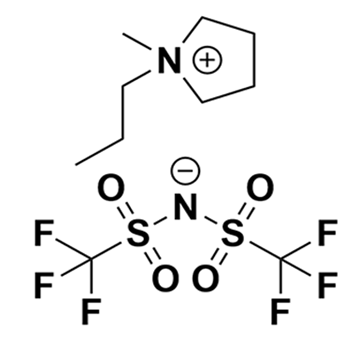
1-Methyl-1-propylpyrrolidinium bis(trifluoromethylsulfonyl)imide, >99.5%
Price range: $106.05 through $1,379.98Product Code: IL-0044-UP -
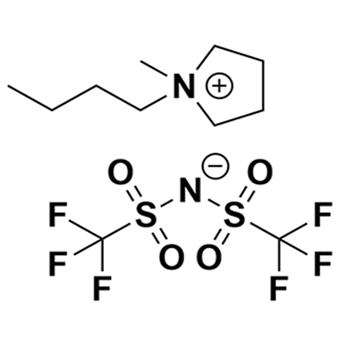
1-Butyl-1-methylpyrrolidinium bis(trifluoromethylsulfonyl)imide, >99.5%
Price range: $106.05 through $1,379.98Product Code: IL-0035-UP -
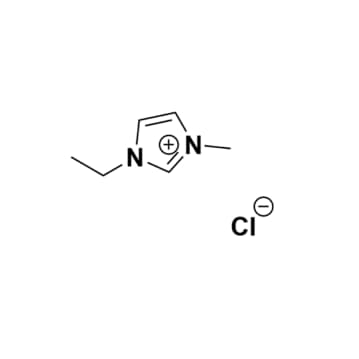
1-Ethyl-3-methylimidazolium chloride, >98%
Price range: $118.78 through $5,050.34Product Code: IL-0093-HP