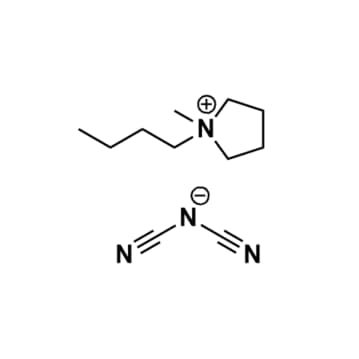
1-Butyl-1-methylpyrrolidinium dicyanamide, >98%
Price range: $200.99 through $2,261.81
Product Code: IL-0041-HPCAS NO: 370865-80-8
- Chemical Formula: C11H20N4
- Synonyms: BMPyrr DCA, PYR14 DCA, PY14 DCA, N-Butyl-N-methylpyrrolidinium dicyanamide
- Hydrophilic
Conductivity: 3.25 mS/cm (24 °C)
SUM Formula: C11H20N4
Molecular Weight: 208.30
Melting Point: -55 °C
Density: 1.02 g/cm³ (20 °C)
ECW: 3.5 V
Purity: >98%
Viscosity: 46 cP (20 °C)
- SUM Formula: C11H20N4
- Molecular Weight: 208.30
- Melting Point: -55 °C
- Density: 1.02 g/cm³ (20 °C)
- ECW: 3.5 V
- Viscosity: 46 cP (20 °C)
1-Butyl-1-methylpyrrolidinium dicyanamide, CAS: 174501-65-6
Key Applications:
Electrochemistry and Energy Storage
- Electrolytes for supercapacitors and batteries
Its high ionic conductivity and wide electrochemical window support stable charge–discharge cycling in carbon‑based and metal‑oxide devices.
- Electrolyte additive for lithium‑ion systems
DCA anion can improve SEI formation and enhance ion mobility in experimental Li‑ion and Na‑ion cells.
- Electrodeposition media
Enables smooth metal deposition (e.g., Cu, Ni) due to its low viscosity and strong solvation of metal ions.
Catalysis and Synthesis
- Medium for homogeneous and heterogeneous catalysis
Supports transition‑metal catalyzed reactions, especially those requiring polar, non‑volatile solvents.
- Stabilization of reactive intermediates
The dicyanamide anion coordinates well with metal centers, aiding in organometallic transformations.
- Solvent for nucleophilic reactions
DCA’s basicity and coordinating ability can accelerate substitution and condensation reactions.
Materials Science and Polymer Processing
- Plasticizer and processing aid
Improves flow and thermal behavior in polymer melts, especially engineering plastics and ion‑conducting polymers.
- Precursor medium for inorganic and hybrid materials
Useful in sol–gel and templating processes due to its thermal stability and low vapor pressure.
- Dispersant for nanomaterials
Enhances dispersion of carbon nanotubes, graphene, and metal nanoparticles.
Separation Science
- Extraction and liquid–liquid separation
Effective for metal ion extraction, particularly transition metals and lanthanides.
- Chromatography solvent modifier
Improves selectivity in HPLC and supports ionic‑liquid‑based stationary phases.
Tribology and Surface Engineering
- Lubricant and anti‑wear additive
Forms stable boundary layers on metal surfaces, reducing friction and wear under high load.
- Corrosion‑inhibiting medium
DCA anion interacts strongly with metal surfaces, offering protective effects in electrochemical environments.
Thermal and Environmental Applications
- Heat‑transfer fluid component
High thermal stability and low volatility make it suitable for closed‑loop systems.
- CO₂ capture research
DCA‑based ionic liquids have been explored for reversible CO₂ absorption due to their tunable basicity.
Please contact us if you want to learn more or need assistance with your order.
Additional information
| Weight | N/A |
|---|---|
| Qty | 25 Grams, 50 Grams, 100 Grams, 250 Grams, 500 Grams, 1000 Grams, 5000 Grams |
Related products
-

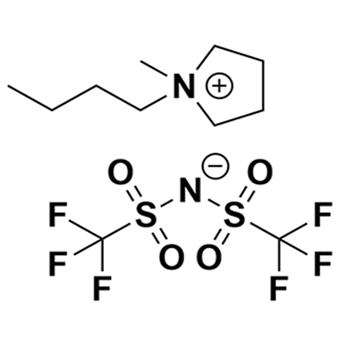
1-Butyl-1-methylpyrrolidinium bis(trifluoromethylsulfonyl)imide, >99.5%
Price range: $106.05 through $1,379.98Product Code: IL-0035-UP -

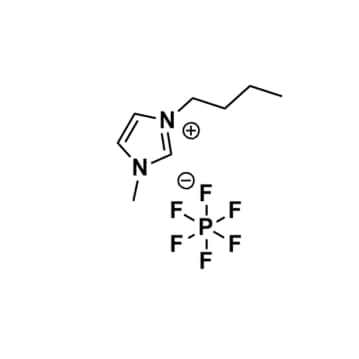
1-Butyl-3-methylimidazolium hexafluorophosphate, >99%
Price range: $57.97 through $3,268.25Product Code: IL-0011-HP -
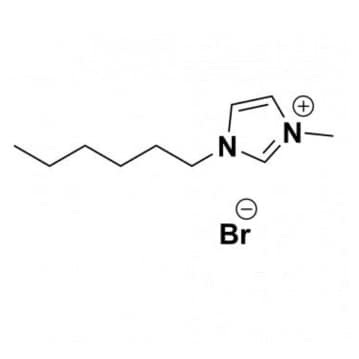
1-Hexyl-3-Methylimidazolium Bromide, >99%
Price range: $161.31 through $1,039.20Product Code: IL-0069-HP -
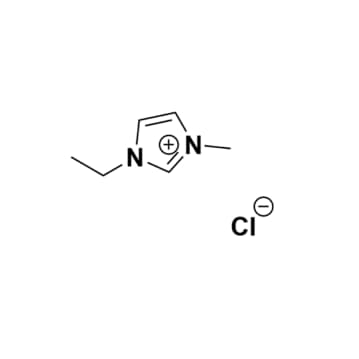
1-Ethyl-3-methylimidazolium chloride, >98%
Price range: $118.78 through $5,050.34Product Code: IL-0093-HP