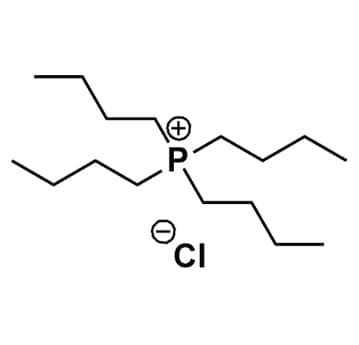
Tetrabutylphosphonium chloride, >95%
Product Code: RIN-0015-TGCAS NO: 2304-30-5
- Chemical Formula: C16H36ClP
- Synonyms: P4444 Cl, tetra-n-butylphosphonium chloride, N-butylphosphonium chloride
This is a custom synthesis product. Price upon request
Please email us at info@roco.global to place an order
SUM Formula: C16H36ClP
Molecular Weight: 294.88
Melting Point: 70-72 °C
Purity: >95%
Viscosity: 179.1 mPa.S (75°C)
- SUM Formula: C16H36ClP
- Molecular Weight: 294.88
- Melting Point: 70-72 °C
- Viscosity: 179.1 mPa.S (75°C)
Tetrabutylphosphonium Chloride, CAS: 2304-30-5
Key Applications:
Phase‑Transfer and Solvent‑Free Catalysis
Tetrabutylphosphonium chloride serves as an effective phase‑transfer catalyst in nucleophilic substitution, alkylation, and condensation reactions. Its strong ion‑pairing behavior supports solvent‑reduced and solvent‑free synthetic routes, enabling greener and more efficient process intensification.
Polymer and Materials Processing
The bulky phosphonium cation enhances compatibility with engineering polymers and elastomers, enabling ion‑exchange modification, melt‑processing adjustments, and rheology tuning. It is used to introduce cationic functionality into membranes, resins, and specialty polymer systems.
Electrochemical and Ionic Conductivity Studies
Its well‑defined ionic structure makes it suitable as a supporting electrolyte or model ionic species for evaluating ion transport, conductivity, and interfacial behavior. It is used in studies of electrode kinetics, charge‑transfer processes, and ionic‑liquid‑based electrochemical media.
Ionic‑Liquid Precursor and Structural Component
Tetrabutylphosphonium chloride functions as a precursor or structural building block for hydrophobic phosphonium ionic liquids. Its tunable cation enables formulation of task‑specific ionic liquids for catalysis, separations, lubrication, and electrochemical applications.
Extraction, Separation, and Ion‑Exchange Systems
The compound participates in biphasic extraction systems for metal ions, organics, and reactive intermediates. Its hydrophobic cation improves phase partitioning and enhances selectivity in liquid–liquid extraction and ion‑exchange workflows.
Electroplating and Surface Finishing
Phosphonium salts, including tetrabutylphosphonium chloride, are used as additives in electroplating baths to improve deposit uniformity, control grain structure, and enhance surface brightness. Their ionic character supports stable bath conductivity and improved metal‑ion transport.
Surfactant and Formulation Science
The compound can act as a structure‑directing agent or co‑surfactant in dispersions, emulsions, and templated materials. Its amphiphilic balance supports micelle formation, nanoparticle stabilization, and controlled assembly of inorganic or hybrid materials.
Fire Retardancy Research and Additive Systems
Quaternary phosphonium salts are investigated as fire‑retardant additives due to their phosphorus content and thermal stability. Tetrabutylphosphonium chloride is used in research on flame‑retardant polymer formulations, char‑forming mechanisms, and synergistic additive systems.
Solubility and Solvation Studies
Its solubility profile in polar and moderately polar organic solvents makes it useful for probing solvation dynamics, ion‑pairing behavior, and solvent–solute interactions. It is employed in studies of ionic‑liquid miscibility, phase behavior, and solvent‑tuning strategies.
Antimicrobial and Preservation Research
Quaternary phosphonium salts exhibit antimicrobial activity against bacteria and fungi. This compound is used in research on surface treatments, coatings, and preservation systems where cationic biocidal mechanisms are relevant.
Related products
-
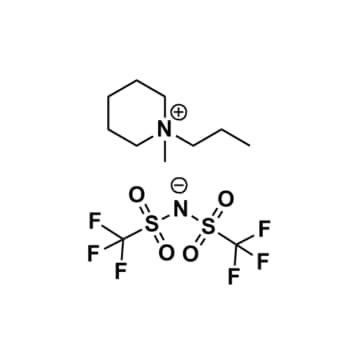
1-Methyl-1-propylpiperidinium bis(trifluoromethylsulfonyl)imide, >99%
Price range: $108.24 through $6,735.96Product Code: IL-0045-HP -

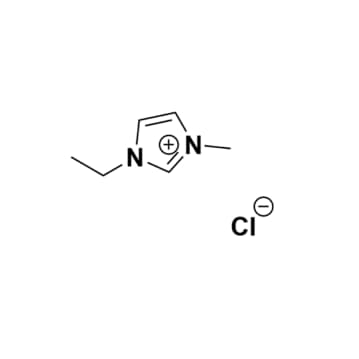
1-Ethyl-3-methylimidazolium chloride, >98%
Price range: $110.88 through $4,709.76Product Code: IL-0093-HP -

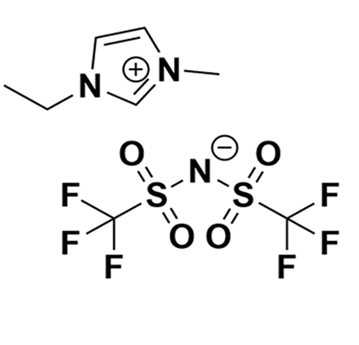
1-Ethyl-3-methylimidazolium bis(trifluoromethylsulfonyl)imide, >99.5%
Price range: $72.60 through $957.00Product Code: IL-0023-UP -
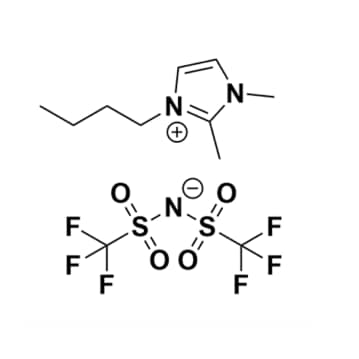
1-Butyl-2,3-dimethylimidazolium bis(trifluoromethylsulfonyl)imide
Price range: $89.76 through $5,937.36Product Code: IL-0104-HP