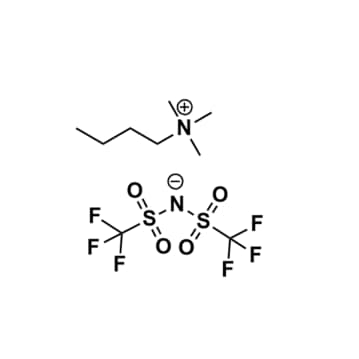
Butyltrimethylammonium bis(trifluoromethylsulfonyl)imide, >99.5%
Price range: $192.46 through $1,602.36
Product Code: IL-0032-UPCAS NO: 258273-75-5
- Chemical Formula: C9H18F6N2O4S2
- Synonyms: N1114 BTA, N1114 NTf 2 , N1114 TFSI, N1114 BTI
- Weakly-coordinating anion
- Hydrophobic
For High-Purity of >99% Purity, refer to IL-0032-HP
Conductivity: 2.86 mS/cm
SUM Formula: C9H18F6N2O4S2
Molecular Weight: 396.37
Melting Point: 7 °C
Density: 1.40 g/cm³
ECW: 6.1 V
Purity: >99.%%
Viscosity: 99.5 cP
- SUM Formula: C9H18F6N2O4S2
- Molecular Weight: 396.37
- Melting Point: 7 °C
- Density: 1.40 g/cm³
- ECW: 6.1 V
- Viscosity: 99.5 cP
Butyltrimethylammonium bis(trifluoromethylsulfonyl)imide, CAS: 258273-75-5
Key Applications:
Electrochemical Systems
- Serves as a high‑stability supporting electrolyte in non‑aqueous electrochemical cells, including lithium, sodium, and multivalent metal systems.
- Enhances ionic conductivity and suppresses parasitic reactions in high‑voltage environments due to the TFSI anion’s oxidative robustness.
- Used in electrodeposition studies where controlled ion mobility and low water content are essential.
Battery and Energy Storage Research
- Functions as an additive or co‑salt in electrolyte formulations for next‑generation batteries, improving SEI formation and cycling stability.
- Supports research on ionic‑liquid‑based electrolytes for solid‑state and hybrid solid–liquid systems.
- Applied in redox‑flow battery development where wide electrochemical windows and thermal stability are required.
Materials Science and Polymer Processing
- Acts as a dopant or ionic modifier in polymer matrices, enabling tunable conductivity in ion gels, block copolymers, and elastomeric materials.
- Used in the preparation of polymer electrolytes and membranes with enhanced mechanical and electrochemical performance.
- Facilitates ion‑exchange processes in advanced materials where hydrophobic, weakly coordinating anions are advantageous.
Catalysis and Synthesis
- Employed as a phase‑transfer or ionic‑medium component in organic synthesis, particularly under low‑volatility or solvent‑free conditions.
- Supports catalytic systems that benefit from the TFSI anion’s non‑coordinating nature, improving catalyst stability and turnover.
- Useful in halide‑free reaction environments where minimal nucleophilicity is required.
Spectroscopy and Fundamental Studies
- Provides a well‑defined cation–anion pair for benchmarking ion transport, solvation, and interfacial behavior in ionic liquid research.
- Used in vibrational, NMR, and dielectric spectroscopy to study ion pairing and dynamic relaxation processes.
- Serves as a model salt for computational and theoretical investigations of ionic liquids with quaternary ammonium cations.
Please contact us if you want to learn more or need assistance with your order.
Related products
-

1-Ethyl-3-methylimidazolium chloride, >98%
Price range: $118.78 through $5,050.34Product Code: IL-0093-HP -

1-Ethyl-3-methylimidazolium bis(trifluoromethylsulfonyl)imide, >99.5%
Price range: $77.88 through $1,109.64Product Code: IL-0023-UP -
Methyltrioctylammonium bis(trifluoromethylsulfonyl)imide, >99%
Price range: $164.15 through $8,170.01Product Code: IL-0017-HP -
1-Butyl-3-methylimidazolium bis(trifluoromethylsulfonyl)imide, >99.5%
Price range: $106.18 through $5,520.31Product Code: IL-0029-UP