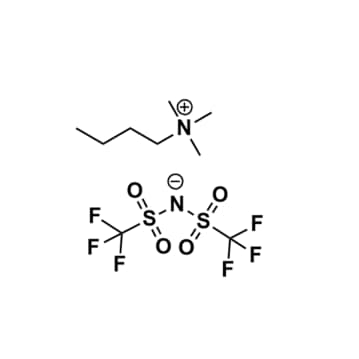
Butyltrimethylammonium bis(trifluoromethylsulfonyl)imide, >99%
Price range: $134.49 through $7,432.55
Product Code: IL-0032-HPCAS NO: 258273-75-5
- Chemical Formula: C9H18F6N2O4S2
- Synonyms: N1114 BTA, N1114 NTf2, N1114 TFSI, N1114 BTI
- Weakly-coordinating anion.
- Hydrophobic
For Ultra-High Purity of >99.5% refer to IL-0032-UP
Conductivity: 2.86 mS/cm
SUM Formula: C9H18F6N2O4S2
Molecular Weight: 396.37 g/mol
Melting Point: 7 °C
Density: 1.40 g/cm³
ECW: 6.1 V
Purity: >99%
Viscosity: 99.5 cP @25 °C
- SUM Formula: C9H18F6N2O4S2
- Molecular Weight: 396.37 g/mol
- Melting Point: 7 °C
- Density: 1.40 g/cm³
- ECW: 6.1 V
- Viscosity: 99.5 cP @25 °C
Butyltrimethylammonium bis(trifluoromethylsulfonyl)imide, CAS: 258273-75-5
Key Applications:
1. Electrochemical & Energy Storage Applications
- Supporting electrolyte in non‑aqueous systems
Enhances ionic conductivity and widens the electrochemical stability window in organic solvents.
- Lithium‑ion and sodium‑ion battery research
Used as an additive or co‑salt to improve SEI formation, suppress dendrites, and stabilize high‑voltage cathodes.
- Supercapacitors and hybrid capacitors
Provides high ionic mobility and low viscosity when paired with compatible solvents or ionic liquid matrices.
- Electrodeposition media
Enables smooth, uniform metal deposition due to its low coordinating TFSI anion.
2. Catalysis & Synthetic Chemistry
- Phase‑transfer catalysis
The quaternary ammonium cation facilitates transport of reactive species across immiscible phases.
- Non‑coordinating reaction medium
TFSI’s weak coordination supports reactions requiring highly reactive cations or electrophiles.
- Organometallic stabilization
Useful for generating stable ionic complexes in low‑nucleophilicity environments.
3. Materials Science & Soft Matter
- Polymer electrolytes
Incorporated into polymer matrices (PEO, PMMA, PVDF) to enhance ionic transport and mechanical flexibility.
- Ion gels and solid-state ionic materials
Forms stable, low‑volatility ionogels for flexible electronics and sensors.
- Antistatic and charge‑control additives
The quaternary ammonium headgroup provides persistent surface charge control in coatings and films.
4. Thermal & Transport Applications
- Heat‑transfer and thermal‑stability studies
High thermal stability of TFSI salts makes them useful in benchmarking ionic liquid performance.
- Solvent‑free ionic media
BTMA‑TFSI can act as a component in eutectic ionic mixtures to tune viscosity, conductivity, and melting point.
5. Separation Science
- Ion‑pairing reagent in chromatography
Enhances separation of polar analytes in HPLC and ion chromatography.
- Extraction and purification systems
Hydrophobic TFSI anion supports selective extraction of metal ions and organic species.
6. Environmental & Industrial Chemistry
- Electrochemical CO₂ reduction studies
Provides a stable, low‑nucleophilicity medium for probing catalytic pathways.
- Corrosion‑resistant ionic environments
TFSI salts are used in testing metal stability under extreme conditions.
Please contact us if you want to learn more or need assistance with your order.
Related products
-

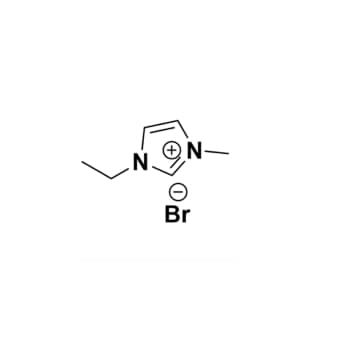
1-Ethyl-3-methylimidazolium bromide, >99%
Price range: $104.69 through $2,471.33Product Code: IL-0015-HP -
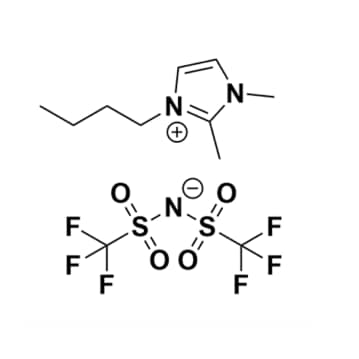
1-Butyl-2,3-dimethylimidazolium bis(trifluoromethylsulfonyl)imide, >99%
Price range: $96.16 through $6,366.66Product Code: IL-0104-HP -
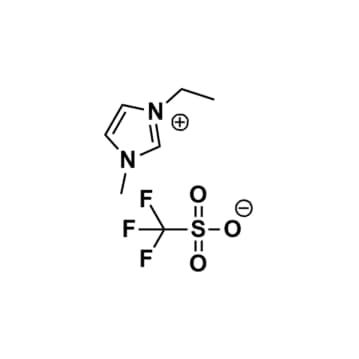
1-Ethyl-3-methylimidazolium triflate, >99%
Price range: $49.57 through $3,674.56Product Code: IL-0009-HP -
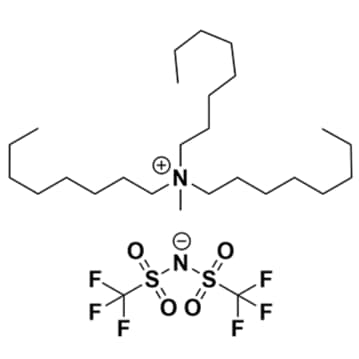
Methyltrioctylammonium bis(trifluoromethylsulfonyl)imide, >99%
Price range: $164.15 through $8,170.01Product Code: IL-0017-HP