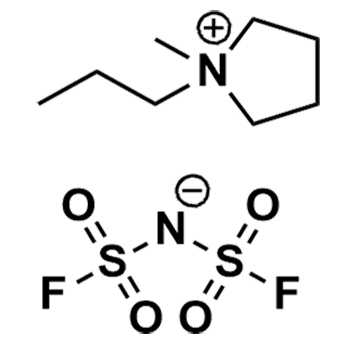
1-Methyl-1-propylpyrrolidinium bis(fluorosulfonyl)imide, >99%
Price range: $137.20 through $1,780.60
Product Code: IL-0344-HPCAS NO: 852620-97-4
- Chemical Formula: C8H18F2N2O4S2
- Synonyms: PMPyrr FSI, PYR13 FSI, PY13 FSI, N-methyl-N-propylpyrrolidinium bis(fluorosulfonyl)imide
- Weakly-coordinating anion
SUM Formula: C8H18F2N2O4S2
Molecular Weight: 308.37
Purity: >99%
- SUM Formula: C8H18F2N2O4S2
- Molecular Weight: 308.37
1-Methyl-1-propylpyrrolidinium bis(fluorosulfonyl)imide, CAS: 852620-97-4
Key Applications:
Electrochemical Systems
- High‑performance lithium battery electrolytes
Utilized as a low‑viscosity ionic liquid cation paired with FSI⁻ to enhance ionic conductivity, SEI stability, and low‑temperature performance in Li‑ion and Li‑metal cells.
- Dual‑salt and localized high‑concentration electrolytes
Supports advanced electrolyte formulations requiring high oxidative stability and improved interfacial behavior.
- Supercapacitors and hybrid capacitors
Provides fast ion transport and stable cycling under wide voltage windows.
Electrodeposition and Surface Engineering
- Metal deposition media
Enables controlled electrodeposition of reactive or air‑sensitive metals (e.g., Al, Mg) due to its wide electrochemical window and thermal stability.
- Corrosion‑resistant coatings
Serves as a non‑volatile, thermally robust medium for uniform metal film formation.
Advanced Materials Processing
- Nanomaterials synthesis
Functions as a tunable, non‑volatile solvent for producing nanoparticles, nanowires, and functional inorganic materials.
- Polymer electrolyte systems
Incorporated into polymer matrices to improve ionic transport and mechanical flexibility.
Catalysis and Chemical Transformations
- Lewis‑acidic or electrochemically active reaction media
Supports catalytic transformations requiring stable, non‑aqueous, ionically conductive environments.
- Fluorosulfonyl‑based reaction systems
Compatible with FSI‑driven activation pathways and electrochemical synthesis.
Thermal and Process Fluids
- Heat‑transfer and thermal‑management applications
Beneficial where low vapor pressure, high thermal stability, and non‑flammability are required.
- Antistatic and antisolvent formulations
Used in specialty processing environments where ionic conductivity and chemical inertness are advantageous.
Analytical and Separation Science
- Chromatographic ionic liquid additives
Enhances selectivity and peak resolution in LC and CE methods.
- Electrochemical sensors
Provides stable ionic environments for high‑sensitivity detection platforms.
Please contact us if you want to learn more or need assistance with your order.
Related products
-

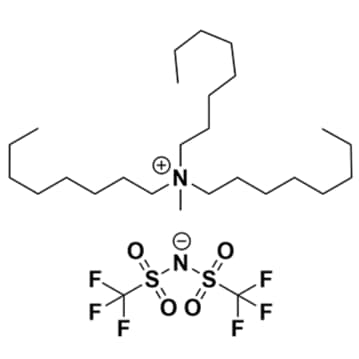
Methyltrioctylammonium bis(trifluoromethylsulfonyl)imide, >99%
Price range: $164.15 through $8,170.01Product Code: IL-0017-HP -
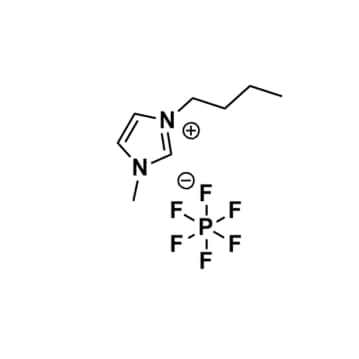
1-Butyl-3-methylimidazolium hexafluorophosphate, >99%
Price range: $57.97 through $3,268.25Product Code: IL-0011-HP -
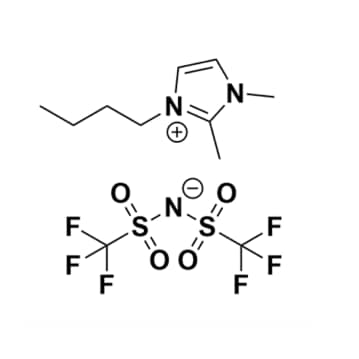
1-Butyl-2,3-dimethylimidazolium bis(trifluoromethylsulfonyl)imide, >99%
Price range: $96.16 through $6,366.66Product Code: IL-0104-HP -

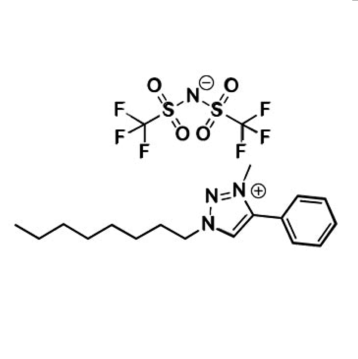
3-methyl-1-octyl-4-phenyl-triazolium bis((trifluoromethyl)sulfonyl)amide
Product Code: TzPhC8FS