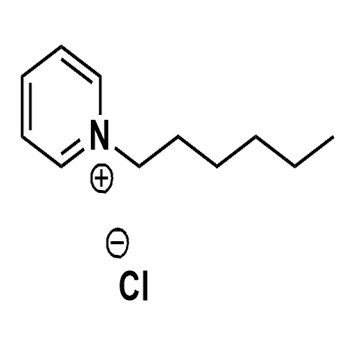
1-Hexylpyridinium chloride, >98%
Price range: $481.21 through $2,713.36
Product Code: IL-0131-HPCAS NO: 6220-15-1
- Chemical Formula:
- Synonyms: HexPy Cl, N-Hexylpyridinium chloride
- Aromatic
SUM Formula: C11H18ClN
Molecular Weight: 199.73
Melting Point: 35 °C
Density: 1.014 g/cm³
Purity: >98%
Viscosity: 4322 cP (25°C)
- SUM Formula: C11H18ClN
- Molecular Weight: 199.73
- Melting Point: 35 °C
- Density: 1.014 g/cm³
- Viscosity: 4322 cP (25°C)
1-Hexylpyridinium chloride, CAS: 6220-15-1
Key Applications:
Electrochemistry & Energy Systems
- Supporting electrolyte for non‑aqueous electrochemical studies requiring wide electrochemical windows.
- Medium for metal and alloy electrodeposition, improving film uniformity and reducing dendritic growth.
- Conductive phase for redox systems, corrosion studies, and ionic‑liquid‑based capacitors.
Catalysis & Organic Synthesis
- Reaction medium for transition‑metal‑catalyzed C–C and C–N bond‑forming reactions.
- Enhances phase‑transfer catalysis, especially for hydrophobic substrates.
- Suitable for microwave‑assisted synthesis due to high polarity and thermal stability.
Extraction, Separation & Solvent Systems
- Solvent for liquid–liquid extraction of metal ions, aromatics, and hydrophobic organics.
- Co‑solvent in biphasic systems requiring adjustable polarity.
- Supports selective partitioning of biomolecules and specialty chemicals.
Materials Science & Surface Engineering
- Additive in polymer blends and composites to tune conductivity, plasticity, and thermal behavior.
- Templating agent for nanoparticle and mesoporous material synthesis.
- Used in surface functionalization of inorganic substrates.
Analytical Chemistry
- Mobile‑phase additive in chromatography to improve peak shape and separation of ionic or hydrophobic analytes.
- Employed in sample‑prep workflows for extraction and pre‑concentration.
Interfacial & Surface‑Tension Applications
- Acts as a surface‑active ionic liquid, reducing surface tension in aqueous and mixed‑solvent systems.
- Used to stabilize foams, emulsions, and dispersions, especially where ionic strength and hydrophobic chain length influence interfacial behavior.
- Improves wetting, spreading, and coating uniformity on metals, ceramics, and polymeric surfaces.
- Supports studies of interfacial charge, micelle formation, and aggregation behavior in soft‑matter and colloidal systems.
- Useful in microfluidic and droplet‑based platforms where controlled surface tension is required for droplet formation and stability.
Please contact us if you want to learn more or need assistance with your order.
Related products
-

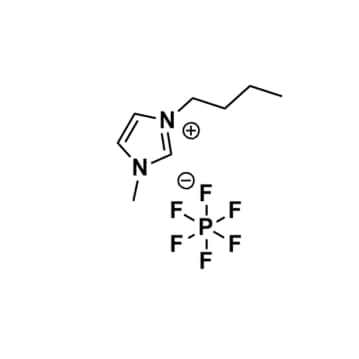
1-Butyl-3-methylimidazolium hexafluorophosphate, >99%
Price range: $57.97 through $3,268.25Product Code: IL-0011-HP -

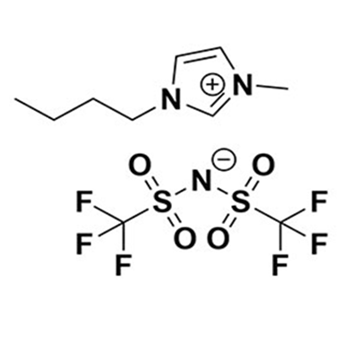
1-Butyl-3-methylimidazolium bis(trifluoromethylsulfonyl)imide, >99.5%
Price range: $106.18 through $5,520.31Product Code: IL-0029-UP -
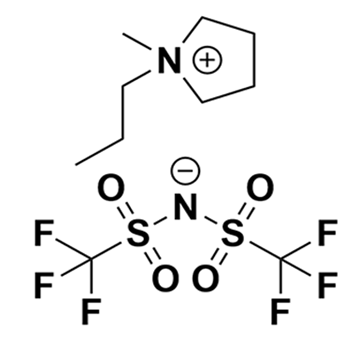
1-Methyl-1-propylpyrrolidinium bis(trifluoromethylsulfonyl)imide, >99.5%
Price range: $106.05 through $1,379.98Product Code: IL-0044-UP -
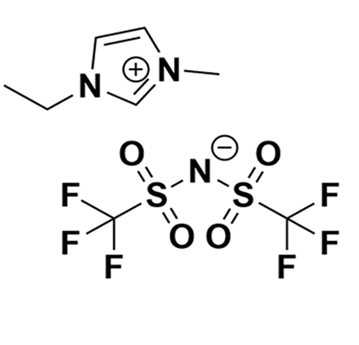
1-Ethyl-3-methylimidazolium bis(trifluoromethylsulfonyl)imide, >99.5%
Price range: $77.88 through $1,109.64Product Code: IL-0023-UP