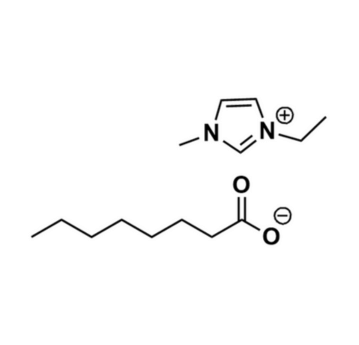
1-Ethyl-3-methylimidazolium octanoate, >98%
Price range: $41.04 through $672.31
Product Code: IL-0357-HPCAS NO: 1154003-55-0
- Chemical Formula: C14H26N2O2
- Synonyms: EMIM Oct, EMIM OOc, EMIM Oc, C1C2Im Oct
Conductivity: 0.20 mS/cm (19 °C)
SUM Formula: C14H26N2O2
Molecular Weight: 254.38
Melting Point: -30 °C
Density: 1.040 g/cm³ (19 °C)
ECW: 5.0 V
Purity: >98%
Viscosity: 799.1 cP (19 °C)
- SUM Formula: C14H26N2O2
- Molecular Weight: 254.38
- Melting Point: -30 °C
- Density: 1.040 g/cm³ (19 °C)
- ECW: 5.0 V
- Viscosity: 799.1 cP (19 °C)
1-Ethyl-3-methylimidazolium octanoate, CAS: 1154003-55-0
Key Applications:
Biomass Processing and Cellulose Solvation
- Effective cellulose solvent due to the combined hydrogen‑bond‑disrupting capability of the imidazolium cation and the moderately hydrophobic octanoate anion.
- Supports dissolution, swelling, and regeneration of cellulose, enabling film formation, fiber spinning, and derivatization workflows.
- Useful in lignocellulosic pretreatment, selectively solubilizing lignin and hemicellulose to improve downstream enzymatic hydrolysis.
Catalysis and Reaction Media
- Provides a medium‑polarity ionic environment suitable for base‑catalyzed, organometallic, and condensation reactions.
- Enhances phase‑transfer behavior in biphasic systems due to the amphiphilic nature of the octanoate anion.
- Stabilizes reactive intermediates in esterification, transesterification, and related transformations.
Surfactant, Emulsion, and Formulation Science
- Exhibits intrinsic amphiphilicity, enabling formation of microemulsions and stabilization of dispersions.
- Functions as a co‑solvent or co‑surfactant in formulations requiring tunable polarity and low volatility.
- Improves nanoparticle dispersion for metal oxides, carbon nanomaterials, and hybrid composites.
Electrochemical and Energy Applications
- Offers moderate hydrophobicity with useful ionic conductivity for low‑voltage electrochemical systems.
- Serves as an ion‑transport medium in polymer electrolytes, gels, and flexible electronic materials.
- Suitable for bioelectrochemical devices where carboxylate anions provide lower cytotoxicity than halides.
Biocompatible and Bio‑derived Systems
- Carboxylate anions such as octanoate are generally less cytotoxic, enabling use in enzyme stabilization, protein extraction, and selective microbial phase systems.
- Supports bioprocessing environments where ionic liquids enhance solubility without denaturing biomolecules.
Polymer and Materials Processing
- Acts as a plasticizer or processing aid for biopolymers including cellulose, chitosan, and PLA blends.
- Enables formation of ionically conductive polymer films for sensors and soft electronics.
- Useful in surface modification workflows where hydrophobic chain length improves adsorption and interfacial behavior.
Please contact us if you want to learn more or need assistance with your order.
Related products
-

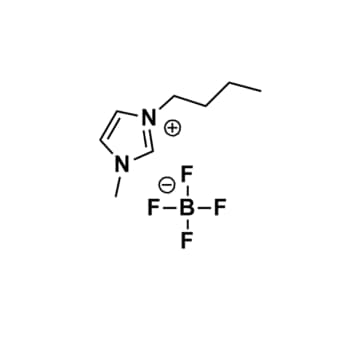
1-Butyl-3-methylimidazolium tetrafluoroborate, >99%
Price range: $52.41 through $2,870.60Product Code: IL-0012-HP -
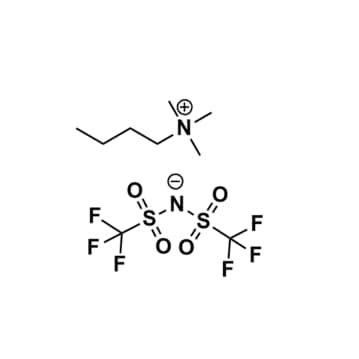
Butyltrimethylammonium bis(trifluoromethylsulfonyl)imide, >99%
Price range: $134.49 through $7,432.55Product Code: IL-0032-HP -
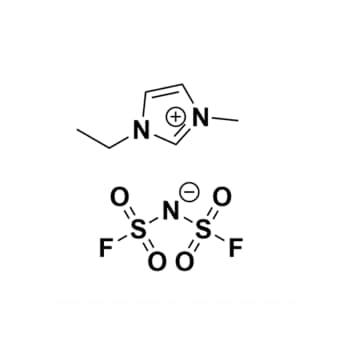
1-Ethyl-3-methylimidazolium bis(fluorosulfonyl)imide, >99%
Price range: $91.96 through $1,224.36Product Code: IL-0342-HP -

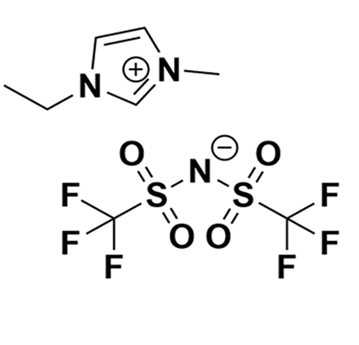
1-Ethyl-3-methylimidazolium bis(trifluoromethylsulfonyl)imide, >99.5%
Price range: $77.88 through $1,109.64Product Code: IL-0023-UP