
Acoustic Performance of Rigid and Flexible Polyurethane Foams (PU) Using Recycled Functional Powder Additives
Noise, Vibration, and Harshness (NVH) performance is becoming a priority across construction materials, industrial equipment, and consumer products. RoCo’s latest white paper demonstrates how recycled polyurethane (PU) powder additives can significantly improve the acoustic behavior of both rigid and flexible PU foams — without changing chemistry, equipment, or manufacturing processes.
Key Findings:
Rigid PU Foam — Softer, Less Harsh Impact Noise
Impact testing shows that adding 5–10% recycled PU powder to rigid foam produces measurable improvements in both sound intensity and perceived harshness.
Key results:
- ~4 dB reduction in peak impact noise at 10% loading
- Dominant frequency shift from 1,837 Hz → 985 Hz at 5% loading
- Lower frequencies (<1,000 Hz) are perceived as softer and less fatiguing

Rigid foam impact results: peak sound intensity (dB) vs. dominant frequency (Hz) by formulation.
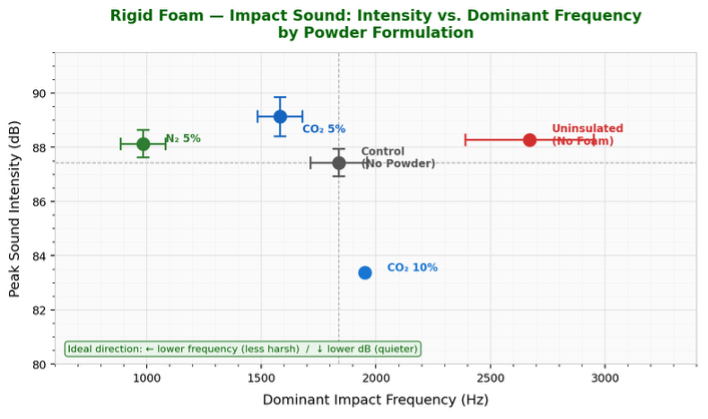
This frequency shift is especially valuable for OEMs targeting comfort and user experience.
Flexible PU Foam — Strong Broadband Attenuation
In sweep attenuation testing, powder‑modified flexible foam delivered strong performance in the frequency range most sensitive to human hearing.
Key results:
- 15–35 dB insertion loss across 1,500–2,500 Hz
- 24.4 dB mean IL for the best-performing formulation
- Consistent broadband attenuation across all loadings
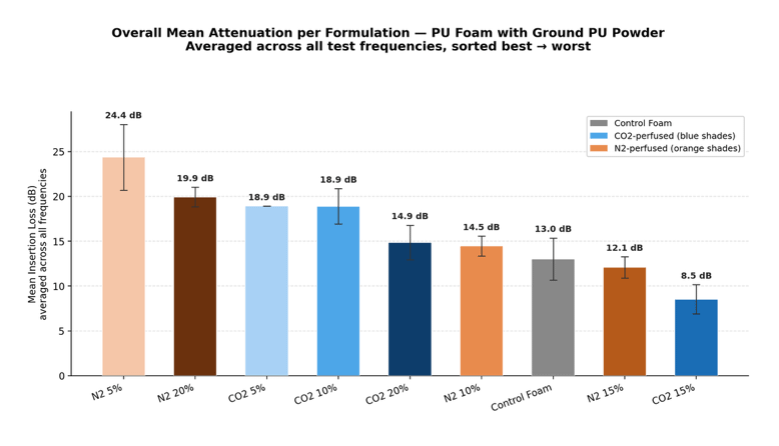
These results make the additive suitable for acoustic panels, insulation, equipment housings, and consumer products.
How the Additive Works
RoCo’s recycled PU powder is produced by mechanically grinding foam while perfusing it with CO₂ or N₂. This process creates functionalized, micro‑porous particles that disperse evenly into the polyol.
Inside the foam, these particles create micro‑interfaces that:
- Scatter and reflect incoming sound waves
- Absorb energy through viscous friction
- Convert acoustic energy into heat
- Shift impact frequencies downward
- Increase broadband attenuation
The mechanism is effective in both rigid and flexible PU systems.
Why This Matters
Traditional PU foams offer limited control over high‑frequency noise — the range where human hearing is most sensitive. By introducing impedance‑mismatch interfaces inside the foam, RoCo’s additive enables tunable NVH performance without requiring any changes to existing manufacturing lines.
This makes it a practical solution for OEMs seeking measurable acoustic improvements with minimal integration effort.
Sustainability Advantage
The powder is made from 100% recycled PU feedstock, supporting circularity and sustainability goals while reducing material costs.
Additional benefits include:
- ~0.15 kWh/kg production energy
- Negligible gate‑to‑gate environmental impact
- Lower cost compared to virgin polyol
- Supports Scope 3 emissions reporting
This positions the additive as both a performance enhancer and a sustainability enabler.
Limitations & Next Steps
The technology is currently in R&D and small‑batch production. Scale‑up is underway, with next steps including:
- A‑weighted acoustic sweeps
- Spectral centroid and decay‑constant analysis
- OEM pilot integration
RoCo is actively preparing for pilot‑scale deployment.